Mostrando postagens com marcador comunismo. Mostrar todas as postagens

sábado, 2 de abril de 2022

USA & NATO vs Russia in Ukraine: Putin is capitalist Russia

It has now been over a month since Vladimir Putin ordered Russian military forces to invade Ukraine in order to provide some relief to the Russian population of Ukraine.  In this short amount of time, a tidal wave of sentimental gush has emerged from America and Europe that has glossed over even the most modest criticism of the Ukrainian government while vilifying Putin and his country to an extent that is increasingly trespassing into the realm of the absurd. This narrative, disseminated by Washington, its allies, and its minions in the corporate-owned media, has been so predictable as to be bordering on self-parody, with some going so far as to draw parallels between Putin and Adolf Hitler. In the wake of this flagrantly one-sided presentation of the conflict, Russia has been subjected to sanctions from the US and its allies, the withdrawal of multiple major corporations from Russian soil, and a series of boycotts by a cornucopia of universities, NGOS and social media companies.

It has been left to independent media, therefore, to provide some modicum of balance and nuance in the face of this growing tide of Russophobia and willful distortion. Thankfully, many others have addressed issues such as: president Volodymyr Zelenskyy’s integration of a neo-Nazi paramilitary group into Ukraine’s national armed forces; NATO encroachment onto Russia’s borders; the West’s failure to honor agreements that Ukraine would not join NATO in the post-Cold War era; the fact that Putin’s actions are supported by (overwhelmingly Russian-speaking) secessionist movements in Ukraine’s eastern provinces due to the Kiev government’s failure to honor the Minsk Agreements; and, perhaps most importantly, the incredible hypocrisy of US sanctions policy given Washington’s not just passive ignoring but active enabling of similar wars waged by its allies such as Saudi Arabia’s war in Yemen, not to mention its own disastrous debacles in Libya, Syria, Iraq, Afghanistan, and Yugoslavia.

But one aspect of the situation that has seemingly received little attention is the background of how and why a man like Putin could have become Russia’s leader in the first place. My intention is not to defend Putin nor to discount the many criticisms one might have of him and his actions in Ukraine. But there is nonetheless a historical context that created the conditions that led to his rise to power. In order to understand this context, we must travel back much further in time than those pushing the Western narrative dare go. We must examine the formation of the present Russian state, which took shape in the aftermath of the collapse of the Soviet Union and the economic conditions that prevailed in its wake.

The story begins in November 1989. The fall of the Berlin wall was heralded as the end of the Cold War and a victory for the West. The triumphalism on the part of Washington and its allies culminated in the famous essay by political scientist Francis Fukuyama that declared “the end of history.” Fukuyama essentially argued that the debate over what economic system and political structures nation states should adopt had ended, with capitalism and liberal democracy emerging as the pinnacle to which all countries ought to aspire.

Central to this narrative was the notion that the socialist system of the USSR and allied Soviet republics had ultimately proven to be a failure. Western population was told that the people of these countries had struggled to overthrow this system and break the “chains of oppression” to which they had been subjected to by the “tyrannical regimes” under which they lived. Images of East Germans celebrating as they literally tore down the Berlin Wall adorned television screens as part of a steady stream of self-congratulatory bromides. The message was loud and clear: the political and economic systems in these countries created a living hell that never should be repeated.

The leaders of these “pro-freedom, pro-democracy” movements, meanwhile, were beatified in Western political and intellectual circles – a message that was dutifully repeated by the corporate media scribes of the time. Figures like Václav Havel and Lech Walesa were hailed as champions of their people and to this day receive gushing hagiographies in the media and the literature of prominent NGOs. The prevailing narrative was Washington’s, that former Soviet bloc countries have transitioned swimmingly to capitalist liberal democracies just like ours and now enjoy the freedoms, prosperity, and civil and political rights that we and our forebears have taken for granted. At the same time, that Putin is an aberration, some kind of 21st century Stalin who has defiled a budding capitalist democracy and turned it into a neo-Soviet hellscape.

All of the above seems so plausible when placed in the context of the post-Cold War narrative Western population has been fed in the more than three decades since 1989. The reality, however, is that this entire narrative is not just a whole-cloth, unalloyed fabrication but also obscures the true reasons for Putin’s rise to power. The truth is that the imposition of capitalism and liberal democratic political frameworks onto the former Soviet states has been an unmitigated disaster that’s left many of these countries impoverished basket cases with declining living standards, unstable economies, and extensive corruption of their political institutions. And Russia is perhaps the paradigmatic example of how this sad story has played out.

In the aftermath of the collapse of the Soviet Union, the transition to so-called “free” markets was not remotely the exercise in energetic entrepreneurialism driven forward by enterprising Eastern Europeans that the Western narrative claims. Rather, the transition was largely a free-for-all in which Western corporations aggressively swooped in and wrapped their tentacles around the local economies of these nations in what became perhaps the biggest fire sale in human history. Across the region, German, American, French, or British investors purchased entire industries with the sole intention of shutting them down in order to create new markets for their own goods. In other cases, factories, airlines, or entire resorts were purchased, broken up, and sold off for parts.

Predictably, domestic industry atrophied because it simply couldn’t compete with the new class of buccaneer capitalists. Whatever protective measures that were implemented in the hope of preventing the buy-out/shut-down model, meanwhile, were easily skirted. In almost all cases, privatization contracts had stipulated that [privatized] enterprises should continue operation for at least two years. But with renationalization as the only punitive measure, it was politically impossible to prevent the abrogation of these contracts. Any government attempts to regulate the market, even in cases of blatant fraud, were coded as “communist.”

Running parallel to this mass privatization of former Soviet bloc economies was a gutting of the state welfare systems that had been implemented by the ousted socialist governments. At the time of the collapse of the USSR and allied Soviet republics, East Germans wanted to keep some of the social supports of socialism in place: guaranteed employment, free education and health care, state-supported maternity leave, and kindergartens that allowed women to better combine work and family life.

Together, these two factors have led to declining living standards for the vast majority of people in these countries. Yet in Western discourse it is usually taken as given that everyone prefers the new dispensation. The reality, however, is that there has always been a diversity of views about the socialist system both before, during and after the fall of the Berlin Wall, running from strong opposition to strong support along with all kinds of positions in between. This nuance gets obscured by the elevation of those most opposed to this system in the Western media along with a deliberate exclusion of every other point of view.

As Zsuzsanna Clark, who grew up in socialist Hungary, put it in a 2009 essay, “the accounts we hear in the West are nearly always from the perspectives of wealthy emigrés or anti-communist dissidents with an axe to grind.” Conversely, Clark explains: “Our voice – the voice of those whose lives were improved by communism – is seldom heard when it comes to discussions of what life was like behind the Iron Curtain.” Clark points out that many were neither in favor of the demise of the old system nor enthusiastic about the introduction of the new. She recalls: “When communism in Hungary ended in 1989, I was not only surprised, but saddened, as were many others. Yes, there were people marching against the government, but the majority of ordinary people – me and my family included – did not take part in the protests.”

Russia has proven to be a particularly egregious case of the twin disasters of rapid privatization and the stripping down of the social safety net. In the aftermath of the collapse of the USSR, the country’s economy was essentially sold off to whoever could buy it up on the condition of being Russian. There were admittedly some schemes to try to “spread the wealth around” such as a voucher system in which the government dispensed “privatization checks” to large swathes of the population, which could then be used to purchase shares of former state-owned companies at public auctions. But the system was easily abused by an emerging class of conniving businessmen who amassed huge quantities of the vouchers by tricking people into selling them to them or exchanging them for mundane consumer goods. This process culminated in the emergence Russia’s “oligarchs” who now own and control many of the country’s major industries, just like the Western oligarchs.

The consequence has been the same as in the United States, Russia’s degeneration into a highly unequal society plagued by rampant poverty. In addition to its contribution to this situation, the rise of the oligarchs has also given lie to Fukuyama’s naïve view that liberal democracy always yields the best results in terms of stability, good governance, and the rule of law. On the contrary, the oligarchs’ power has meant a comprehensive corruption of Russia’s political system, which itself has been a significant factor in Putin’s rise and consolidation of power. This fits within a broader trend of capitalist liberal democracies’ tendency to end up with a form of state capture in which political institutions are manipulated by private interests to such an extent that elected leaders govern to the benefit of these interests more than to the benefit of their voters. Just like in the US. The difference being who controls who. In the US the corporations elects and controls the president. In Russia, it is the president, Putin, who controls the corporations. And that is too much for American presidents and corporations to swallow.  

As a result of the above factors, recent survey evidence shows that many Russians now believe that they were better off before the fall of the Berlin Wall. An opinion poll conducted by the independent Levada Center in 2020, for example, found that 75 percent of Russians feel that the “greatest time in the country’s history” was during the Soviet era. Another Levada Center poll taken the previous year found that 59 percent of Russians believe that the USSR government “took care of ordinary people.” Polls in other former Soviet bloc countries tend to yield similar results. There is even evidence that a reformed model of socialism was exactly what most people in these countries wanted in the first place. A 1989 opinion poll in East Germany found that 89 percent of the country’s residents wished for a transition toward a “better, reformed socialism” while just 5 percent said they would prefer a “capitalist path.”

Indeed, there is also evidence to suggest that most Russians also would have preferred a continuation of socialism even before the degeneration of Russia into today’s quagmire. Many forget that in the year before the 1996 presidential elections, the US-backed Boris Yeltsin was polling at below three percent, well behind Communist Party candidate Gennady Zyuganov. Yeltsin’s unpopularity stemmed in large part from his role in overseeing the imposition of neoliberal capitalism that had by then already led to the demise of domestic industry, crumbling infrastructure and falling living standards.

Zyuganov was on course to victory. But Washington, fearing a reversal of Yeltsin’s neoliberal policies and a return to socialism, intervened to make sure its favored candidate won. In addition to assisting Yeltsin’s political campaign, the Clinton administration instructed the International Monetary Fund (IMF) to issue his government with what was then the second-largest loan in its history. This allowed Yeltsin to pay wage arrears to public sector workers as well as splash on a series of vote-courting spending sprees, which gave him a sudden surge in the polls. With the playing field so severely tilted, Zyuganov ultimately couldn’t close the gap and Yeltsin won the election with just over 50 percent of the vote.

With a second term in office secured, he then proceeded to oversee the completion of the West’s plan to “liberalize” Russia’s economy. As his second term in office came to an end, the damage was so great that male life expectancy in Russia had fallen to 58 years. As a result, to this day Yeltsin remains a widely despised figure amongst ordinary Russians. In 1999 Putin began his first campaign for the Russian presidency in this context of foreign intervention, economic chaos and increasing social insecurity.

This entire episode, of course, demonstrates just how dishonest and self-serving the Western narrative about the Soviet system was and continues to be, whether it be with respect to Russian people’s views about that system or their views about what should replace it. But in addition, it also exposes that Washington’s purported motive of wanting to “liberate” them and bestow them with a “democratic system” was a complete lie. Clearly, Washington was never interested in whether Russia and other former Soviet bloc countries became democratic or not, but rather they whether or not they were compliant in opening up their markets to Western corporate interests.

And ironically, though Washington characterized the prospect of a Zyuganov victory as a regression to (largely fictitious) breadlines and empty shelves, his policy platform was not even proposing an all-out return to the Soviet era but rather a more moderate, decentralized, and democratized form of socialism. Moreover, the Russian Communist Party had actually already been undergoing a process of reform and moderation even before the collapse of the USSR. Shortly before the fall of the Berlin Wall, the party had begun moving toward a model of socialism based on the concepts of “Perestroika” and “Glasnost.”

Of course, we never got to see how these reformist trends would have panned out given that they were stopped in their tracks just as they were getting off the ground. But in any case, evidently the Soviet system was far more popular than is generally understood in the West and, whatever its faults, the imposition of unfettered capitalism has patently been much worse.

Though still reeling from its defeat in the 1996 election and subsequent failures to win back power, the Communist Party remains both the largest opposition party in the Russian Duma (parliament) and the second largest party overall in terms of seats after Putin’s own United Russia party. It is also the only party other than United Russia that has experience in government at the national level. The most likely alternative to Putin, therefore, is a Communist Party-led government that would both threaten the interests of Western corporations and, worst still from Washington’s perspective, risk the reemergence of a system that provides an alternative to the Western model of unfettered globalized capitalism.

Given the above facts, Putin’s rise to power makes perfect sense. His voters can hardly be blamed for wanting a strongman as their leader who can at least impose some kind of order onto the chaotic situation that Russia has found itself in in the decades following the collapse of the USSR. Having created this situation and the corresponding rise of the oligarchs (who have a vested interest in continuation of the status quo), the West has only itself to blame for Putin’s rise. And in a stunning irony, as much as Washington and its allies say they despise him, it’s all but certain that they would like the alternative even less.


domingo, 28 de outubro de 2018

Erdogan has his revenge on MBS BRASIL, ELE não me representa. Resistência!

"A vida é uma luta permanente. Os únicos derrotados são os que cruzam os braços."
Vamos nos encontrar?
O candidato da exclusão, do ódio, da desigualdade, do racismo, da ignorância, da violência, do preconceito, do egoísmo, do obscurantismo, foi eleito.
Como somos cidadãos responsáveis e respeitáveis, acatamos a opinião da maioria, o direito de voto é precioso demais. Respeitamos e prezamos a democracia, por isso, não vamos deixar o presidente eleito cercear nossa liberdade nem violar nossos direitos humanos fundamentais de ir, vir, pensar, falar e viver como nos aprás.
A luta pela democracia continua hoje, de cabeça erguida, de mãos dadas com os amigos e desconhecidos que encontramos pelo caminho do combate pacífico pela virada.
Estaremos atentos.
Hitler foi eleito em 1933 e em dois anos já estava pisoteando a Constituição da Alemanha. Não deixaremos Bozonaro fazer isso com a nossa.
Não nos calaremos.

Resistiremos.
"Ame-o ou Deixe-o", nunca mais! 
O Brasil é nosso.
O Brasil é de todos os brasileiros.
O Brasil jamais será uma arma dele contra nós.
O Brasil jamais será uma arma dele contra nossas diferenças, que tanto nos reforçam.
O Brasil jamais será uma arma dele contra a tolerância e a solidariedade que nos engrandecem e que nos unem hoje como na Inconfidência.
O Brasil jamais será uma arma dele contra a nossa pátria.

Compared with the United States and Saudi Arabia, against the odds, Turkey appears to have gained the most out of the crisis over the assassination of Saudi Commentator Jamal Khashoggi. The fact that the kingdom of Saudi Arabia has had the most to lose is obvious, and the Trump Administration at best looks like it is caught between the Scylla of trusting an ally too much and the Charybdis of being an accessory by failing to heed bi-partisan pressure for accountability and mete out repercussions for the act.
Whereas Turkey has skillfully managed the incident to its advantage, partly by putting pressure on Saudi Arabia and partly by using the crisis as a means to recast its relations with the US and the West. It is not in Turkey's interest to have an ugly open diplomatic battle with Saudi Arabia, but Turkey does compete with it for influence in the Arab world. In addition, Turkey's President Recept Tayyip Erdogan resents the foreign policy acts of Saudi Arabia as directed by the kingdom's de-facto leader Crown Prince Mohammed bin Salman (aka MBS). While Turkey probably won't cross the ultimate red line of lambasting MBS directly, by adeptly leaking damning details of the investigation to the international press it has put considerable pressure on Saudi Arabia and even appears to have knocked it down a few pegs in the international order.
In his first major speech on the topic this week, Erdogan described Khashoggi as "the victim of a vicious murder" and called for an independent international investigation into the incident. But while he used words of respect for King Salman, he did not refer directly to MBS by name. He called for the suspects to be tried in Turkey, as opposed to being protected by diplomatic immunity. He went on to ask a series of questions, such as where the body is and who the local collaborator is that Saudi Arabia says the body was handed over to. Moreover, he demanded to know who had ordered the operation indicating, Ankara is likely to keep the pressure on Ryad.
Less expected, however, had been how adroitly Turkey - which has demonstrated a lack of skilled diplomacy in recent years - is showing the utility of crises by manoeuvring to put its relationship with the West, primarily with the US, back on an even Keel. The release of the arrested American pastor Andrew Brunson was not the only indication of this diplomatic pivot, but certainly the most visible one. Turkey had arrested him on "terror" charges and refused to release him, even though it had unsuccessfully negotiated with the US in recent months over terms of releasing him in exchange for Washington agreeing to drop its sanctions-busting investigation into Turkey's state-owned Halkbank.
Turkish relations with the West have deteriorated in recent years as Erdogan has grown more authoritarian domestically and more contrarian in dealing with fellow NATO allies. The Turkish president has long been frustrated by the EU's insistence on deeper democratic and rule of law reforms, and more recently angered by the US' unwillingness to hand over Fethullah Gulen, the Turkish Muslim leader Ankara believes to be behind the July 2016 failed coup attempt, to Turkish authorities and its support for Kurdish forces in Syria. Particularly after the unsuccessful coup attempt, Erdogan has moved closer to Russia, despite a Russian warplane being shot down by a Turkish fighter jet in 2015, and the Russian ambassador to Turkey being assassinated by a Turkish citizen a year later.
Other ways Turkey has been acting more in the interests of the West include how it is cooperating with the US in northern Syria in the town of Manbij, where it is coordinating patrols with the US in an effort to keep the Kurdish Syrian Defense Forces (SDF) out of the town - despite recent threats not to do so. In addition, Erdogan had a  make-up meeting with Chancellor Angela Merkel in Berlin. And most significantly Turkey pulled off a fairly miraculous forestalling of what appeared to be an impending Syrian-Russian-Iranian attack on Idlib that could have displaced and/or injured several million refugees living in the last major stronghold of the Syrian opposition. The most recent move has involved helping the West seek justice over the Khashoggi killing, with the Brunson release occurring in the first week of these efforts.
These unexpected pro-Western gambits certainly amount to something, at least an apparent about-face for Erdogan. Only recently he was railing against the US for its sanctions over Brunson, and the economic fallout for Turkey that has been so damaging. However, they prompt the question: does this represent a new pattern of cooperating with the US and the West, or is this merely a temporary means of giving Turkey its day in the sun ahead of a coming return to recent form of antagonizing the West whenever Erdogan finds it convenient?
Certainly, the US and its allies hope it is the former. For it was not long ago when Turkey had emerged as a regional superpower, the only democratic and capitalist Middle Eastern country and a willing bridge between the Muslim and Western world. This was early in Erdogan's run as Turkey's long-standing leader, first as prime minister and later as president. Turkey, during this period late in the Bush Administration and early in the Obama administration, was a net benefit to the global community, providing sturdy leadership and engaging in creative diplomacy such as helping bring a more lasting peace to Cyprus.
But as a US diplomat once memorably stated it, "dealing with Turkey is like peeling an onion" - meaning dealing with Turkish diplomats have always been difficult, as even if one matter got sorted out there would always be another one about which it would be difficult to find a communal way forward on. For years this was only the case in diplomatic discussions, such as in Brussels, but in the end Turkey could be counted on in strategic terms as a key member of NATO in a crucial region of the world. However, as President Erdogan began evincing autocratic tendencies, western relations with Turkey have grown more strained up through the recent era of Turkey repositioning itself as more an ally of Russia than its formal NATO allies.
Relations with Turkey have never been easy, but in the past even if Turkish officials proved difficult in diplomatic discussions, they often acted pragmatically in practice by, for instance, joining EU foreign and security operations on the ground with Turkish personnel and funding. In the age-old EU-NATO disputes involving Greece being in the EU and Turkey being in NATO, Turkey was often the more pragmatic of the two. But it may prove too much for the West to begin trusting its formal Turkish ally again, primarily because it is difficult to imagine President Erdogan resisting the next temptation to thunder against anyone at home or abroad who does something to annoy him.

Like the United States and Saoudi Arabia, the third member of the Middle East’s axis of evil, Israel, gets away with murder, both figuratively and literally, too.
But because Israel is a state protected by international Zionism, despite years of extreme-rightwing rule, its atrocities are confined, for the most part, to its own sliver of the world.
Nevertheless, its effect on world affairs is extensive and profound.
Israel and Saudi Arabia used to be mortal enemies.  Though hardly close friends now, they have become de facto allies.
To make their mark on the world, they are both utterly dependent on the United States.  The United States depends on Saudi Arabia for its oil, for the financial clout its oil makes possible, and for keeping the global oil market on track in ways that accord with America’s global interests. Israel has nothing comparable to offer the United States – it is no longer even useful as an off-shore military base — but the political clout of the Israel lobby, both Jewish and Evangelical Christian, more than makes up for the deficit.
I believe that these lobbies, the Zionist one especially, are paper tigers and that this will become apparent to everyone if and when they are boldly defied.  But the American political class thinks differently, and that is all that matters.
In any case, their relations with the United States are not what is holding them together.  Their animosity towards Iran is the reason for that.
The United States has it in for Iran in large part because its foreign policy establishment l holds a grudge for the humiliation America suffered during the hostage crisis four decades ago.
To be sure, the United States is, for the most part, just what as Gore Vidal famously said it was, the United States of Amnesia.  The bromance now flourishing between two of our most loathsome domestic political figures, Trump and Ted Cruz, attests to that.
But, like everything else in the Middle East, the situation is complicated.  At the same time, that, on most matters, the past might as well never have happened, the hegemon’s memory is long when its global dominance is challenged.
Therefore, whenever it is convenient to vilify Iran, American politicians generally will do precisely that. Even thoughtful ones, like Barack Obama, after trying meekly to chart a new course in American-Iranian relations, beat a hasty retreat at the first signs of trouble.
The Saudis have it in for Iran – and Turkey too, to a lesser extent – because, despite the retrograde nature of their regime, they want to become the regional hegemon for the entire Middle East, not just the Arabian Peninsula.
But great power politics is not the whole story.  Saudi Arabia and Iran are rival theocracies; their animosities therefore transcend the bounds of Reason, passing over, as religious conflicts often do, into a realm where irrational fervor sometimes overwhelms calculations of economic and national interest.
Israel’s problem with Iran is different.  It has no hegemonic aspirations; it is happy for the United States to monopolize that. And although secularism is in retreat in Israel, the country is still far from becoming a theocracy.
It is relevant too that in Jewish lore, Persia (Iran) has always been held in high regard.  The thinking of the European Jews who colonized Palestine was, of course, affected by  Orientalist attitudes, but, like other Europeans, European Jews generally held Persians in higher regard than the Arabic speaking peoples under Ottoman – and later British and French – rule.
In short, Israel and Iran are neither natural nor historical enemies.
But to flourish and perhaps even to survive, Israel needs enemies; it always has and as long as it purports to be a Jewish state, it always will.  With anti-Semitism on the wane, despite what Zionists would like the world to think, it therefore needs to concoct credible “existential threats.”  Iran is its best, perhaps its only, chance for that.
Paradoxally, Jews fared better under Islam than they did in Christendom, and modern anti-Semitism owes a great deal to Christian anti-Judaism.  Muslim anti-Judaism, such as it is, has had almost nothing to do with the rise of modern anti-Semitism or with its nature.
Apologists for Israel nowadays struggle to conflate occasional expressions of anti-Zionist outrage in suburban quarters of European cities with the anti-Semitism that led to the Final Solution.  There are a lot of susceptible people in the world these days begging to be fooled, but, in the end, theirs is a fool’s errand.
It should go without saying that anti-Semitism and anti-Zionism are historically and conceptually distinct.
The original Zionist idea was that anti-Semitism would always be with us and that, if only for the sake of self-defense, the Jewish people need a state of their own.   The idea that this state had to be in Palestine came later, as did the idea that support for a Jewish state in Palestine is an expression of Jewish Identity.
Indeed, it was once a widely accepted tenet of the Jewish religion that, until the Messiah comes, Palestine was to be a holy land, not a homeland.  This is still the view of many extreme orthodox Jews today.
It was a holy land too for Old Testament besotted Anglo-Protestants and Lutherans in Germany and the Scandinavian countries.
Today, Zionism is mainly a form of Jewish identity politics, with a stolen nation serving as a substitute for God.
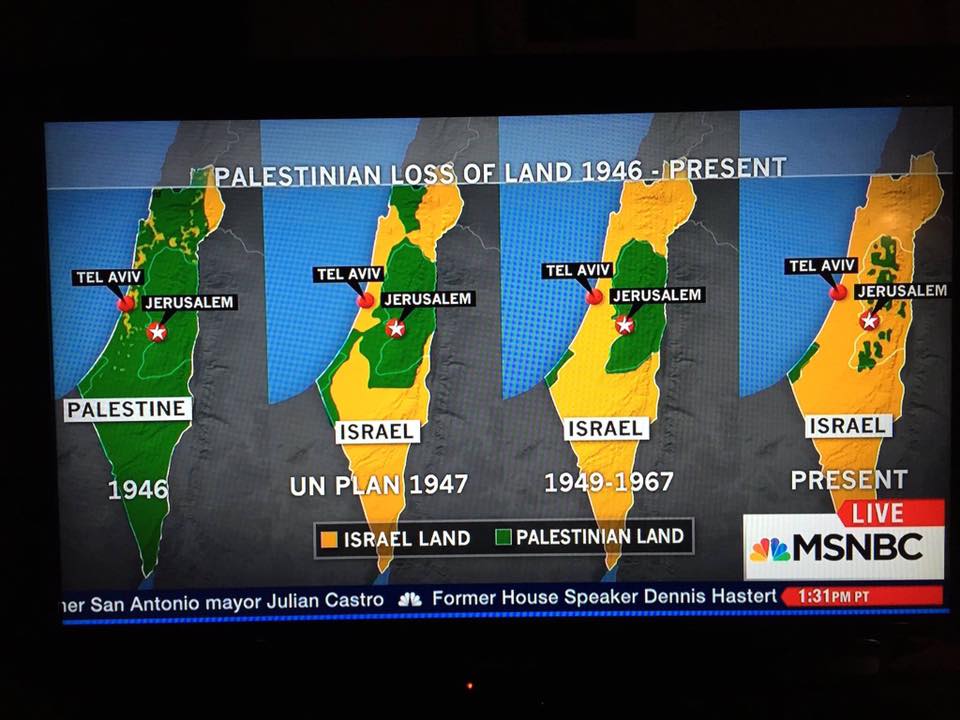
But nations are not part of the furniture of the world; they are socially and politically constructed. This is especially true of the Jewish nation, formed from peoples who share a common religion, but not a common language or culture, except liturgical Hebrew, a shared history or a shared stolen land. Jewish nationalism is a slender reed upon which to base Zionist theory and practice.
Palestinians under occupation and in exile used to serve the purpose of being "threats to the ethnocratic character of the Jewish state". But, by now, they are too politically divided, too abandoned by the world, and too militarily feeble to fool anybody who is not begging to be fooled.
And, of course, the Saudis and the Arab regimes they control are of no use either; they have become Israel’s friend – not officially, but in ways too obvious to hide.
Jordan is and always has been useless, and after the Bush-Cheney war of choice in Iraq, Iraq now is too. Then came the utter and complete mess that the Obama administration, led on by the always inept Hillary Clinton and the liberal imperialists she and Obama empowered, made of Libya and Egypt, and, worst of all, Syria.
And so, Iran is all that is left.
Netanyahu is obsessed with Iran, and therefore so is Trump.  He may aspire to be the Absolute Leader of the Universe but, in fact, he dares not displease Sheldon Adelson and the Israel lobby leads him around by the nose. Adelson, by the way, is living proof that classical anti-Semitism is finished in the United States.  The man is a quasi or bona fide fascist and nobody seems to care.
Netanyahu has the bomb and he has the Israel lobby, but he doesn’t have anything like the Saudis’ money; and, in capitalist America, money talks.
But after the Khashoggi murder it may not talk loud enough.
Therefore, if Netanyahu is to succeed in getting the USA to go to war with Iran, he may have to do the heavy lifting himself.  Is he up to the task?  Don’t count on it.
Let’s hope instead that Israel’s inherent weakness and Netanyahu’s own ineptitude does him in along with his even more odious axis of evil partners, and ultimately the axis itself.


The Israeli conservative newspaper The Jerusalem Post reported that "Saudi Arabia and Israel held secret meetings which led to an estimated $250-million deal, including the transfer of Israeli espionage technologies to the kingdom, Israeli media reported on Sunday, citing an exclusive report by the United Arab Emirate news website Al-Khaleej.
Some of the spy systems, which are the most sophisticated systems Israel has ever sold to any Arab country, have already been transferred to Saudi Arabia and put into use after a Saudi technical team received training in operating them, the report Added.
The exclusive report also revealed that the two countries exchanged strategic military information in the meetings, which were conducted in Washington and London through a European mediator.
Such cooperation would not be the first of its kind between Israel and Saudi Arabia.
In September, Al-Khaleej reported that Saudi Arabia had purchased Israel’s Iron Dome missile defense system to defend itself from Houthi missile attacks.
The deal, which was reportedly mediated by the United States included further plans to reach an agreement on broad military cooperation between the two countries.
While Israel has no official ties with Saudi Arabia, the relationship with the Sunni kingdom and other Gulf states has grown stronger in recent years, due in large part to the shared threat of Iran’s expansion across the region.
IDF Chief of Staff Lt.-Gen. Gadi Eisenkot met with his counterparts from several Arab countries, including Saudi Arabia’s Chief of Staff Gen. Fayyad bin Hamed Al-Ruwaili, in mid-October while in Washington for the Countering Violent Extremist Organizations Conference for military commanders.
While this seemed to be the first publicized meeting between Eisenkot and Al-Ruwaili, it was the second consecutive year the two attended the military commanders’ conference.
Last November, following Eisenkot’s first participation in the conference, he offered to share Israeli intelligence about Iran with Riyadh, telling the Saudi newspaper Elaph in an unprecedented interview that what he heard from the Saudis about Iranian expansion was “identical” to Israeli concerns."

PALESTINA

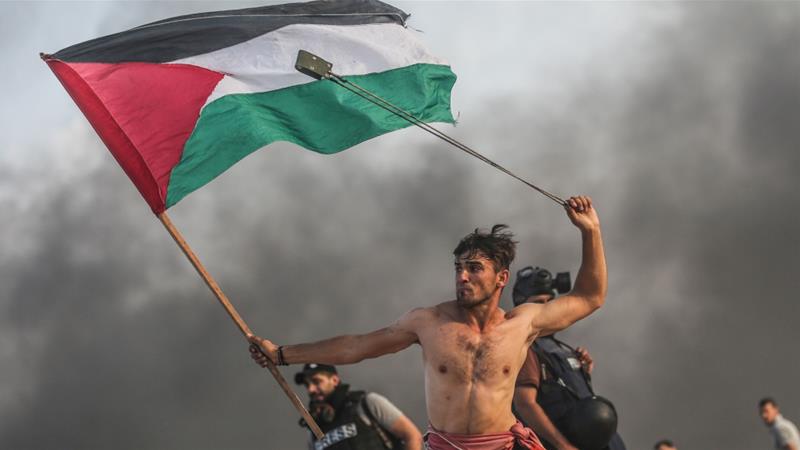
#StopTheWar is a hashtag coming from many activists in #Gaza who urge the international community to hinder Israel’s attempts to launch another large-scale aggression against the occupied, blockaded, unlivable, and exhausted Gaza Strip. #GazaUnderAttack.
The people of Gaza have been subjected to decades of expulsion, occupation, siege and massacre. They have now seized control of their Fate. They are risking life and limb as they protest nonviolently to reclaim their basic rights. It takes just one minute to send a video showing your support for Gaza in its moment of truth. Do it now! Send your videos to METOOGAZA.COM.
Renowned scientists urge cientific Community to consider the facts before engaging in activities with Israeli colonial-based Ariel University, and not engage any attemps to use science to normalise Israel(s occupation of the Palestinian territory.
INTERACTIVE: Palestinian Remix


OCHA  


BRASIL
The Intercept Brasil
Um professor encara o fascismo no dia 31 de outubro (4')