
Haftar, who was once an intimate of the United States’ Central Intelligence Agency (CIA), is now prosecuting a seemingly endless and brutal war against the United Nation’s recognized Government of National Accord (GNA) based in Tripoli and led by President Fayez al-Sarraj. To make matters more confusing, Haftar takes his "legitimacy" from another government, which is based in Tobruk, and is formed out of the House of Representatives (HOR).
However, the quiet in Tripoli is often deceitful. Militias continue to patrol the streets along the Salah al-Din Road near where he lives; the rattle of gunfire is anticipated.
On July 8, United Nations Secretary-General António Guterres made a statement that could have been delivered at any point over the last decade. “Time is not on our side in Libya,” he announced. He laid out a range of problems facing the country, including the military conflict, the political stalemate between the GNA and the HOR, the numbers of internally-displaced people (400,000 out of 7 million), the continued attempts of migrants to cross the Mediterranean Sea, the threat from COVID-19, and the “unprecedented levels” of “foreign interference.”
The UN Human Rights Council passed a resolution to send a Fact-Finding Mission to Libya to investigate human rights violations in this war, including the mass graves found in Tarhouna. The credibility of the Council is in doubt. An earlier Commission of Inquiry on Libya set up in 2012 to study war crimes in 2011-2012 was shut down largely because the North Atlantic Treaty Organization (NATO) refused to cooperate with the investigation. A second inquiry, set up in March 2015, closed its work in January 2016 with the political deal that created the Government of National Accord.
António Guterres did not mention the NATO war in 2011. It seems that he wants to appoint a joint Special Representative with the African Union and he would like a full review of the UN mission. All that is well and good; but it is short of what is necessary: an honest look at the NATO war that broke the country, fomenting a conflict that seems without end.
Statements about Libya drip with evasion. These terms—“foreign interference” and “foreign-backed efforts”—are dropped into conversations and official statements without any clarification. But everyone knows what is going on.
Benghazi is under the control of General Haftar. The government in Tripoli is backed by the United Nations, Turkey and others; while Haftar is backed by Egypt, France and others. At the core, this is a dispute between two regional powers (Turkey and Egypt) as well as a contest between the Muslim Brotherhood (Turkey) and its adversaries (Egypt and the United Arab Emirates). Wrapped up in all this are contracts for offshore drilling in the eastern Mediterranean Sea, which additionally involved Cyprus and Greece.
It is not enough that this is a regional conflict. There is accumulating evidence that General Haftar is being supported by armed mercenaries (from Russian Muslim provinces and Sudan) and by arms shipments from France, while the United States seems to have hedged its bets with support to both sides in the conflict in order not to bet on the wrong horse.
Last year, General Haftar’s forces moved swiftly toward Tripoli, but were eventually rebuffed by the intervention of Turkey (which provided the Tripoli government with military aid as well as Syrian and Turkish mercenaries).
In late December, Turkey formally signed a military and security agreement with the Tripoli-based GNA, which enabled Turkey to transfer military hardware. This agreement broke the terms of the UN resolution 2292 (2016), recently reaffirmed in UN resolution 2526 (2020). Egypt and the United Arab Emirates have openly been supplying Haftar.
Now, the forces of the Tripoli government have moved to the central coastline city of Sirte, which has emerged as the key hotspot in this contest.
The Tobruk government, which backs General Haftar, and a pro-Haftar tribes council urged Egypt’s General Abdul Fatah El Sisi to intervene with the full force of the Egyptian armed forces if Sirte falls to the Turkish-backed government. Egypt’s military drill—called Hasm 2020—came alongside the Turkish navy’s announcement of maneuvers off the Libyan coast—called Navtex.
This is a most dangerous situation, a war of words escalating between Turkey and Egypt; Egypt has now moved military hardware to its border with Libya.
Of course, oil is a major part of the equation. Libya has at least 46 billion barrels of sweet crude oil; this oil is highly valued for Europe because of the low costs to extract and transport it. Countries like the UAE, which are pushing the embargo of Libyan oil, benefit from the withdrawal of Libya, Iranian, and Venezuelan oil from already suppressed world oil markets. Libya’s National Oil Corporation (NOC) has stopped oil exports since January; from about 1.10 million barrels per day, Libyan oil production fell to nearly 70,000 barrels per day.
Neither Haftar nor the Government of National Accord in Tripoli can agree on the export of oil from the country. Oil has not left the country for the better part of the past six months, with a loss—according to the NOC—of about US$6.74 billion. General Haftar controls major oil ports in the east, including Es Sider, and several key oil fields, including Sharara.
Neither side wants the other to profit from oil sales. The United Nations has intervened to try and resolve the differences, but so far there has been limited progress. The entire conflict rests on the belief that either side has that it could win a military victory and therefore take the entire spoils; no one is willing to compromise, since any such agreement would mean a de jure partition of the country into its eastern and western halves with the oil crescent divided between the two.
UN Secretary-General Guterres has surrendered to reality. In his recent statement on Libya, he listed a series of “de-escalation efforts, including the creation of a possible demilitarized zone”; this “demilitarization zone” would likely be drawn somewhere near Sirte. It would effectively divide Libya into two parts.
I don't know any Lybian who would like their country to be partitioned, its oil then siphoned off to Europe, and its wealth stolen by oligarchs on either side. They had misgivings about Muammar Qaddafi’s government in early 2011; but now all Lybians I know and hear of (outside the warlords cycle) regret the war that has ripped their country to shreds.
PALESTINA


 In a recent TV discussion, a respected pro-Palestine journalist declared that if any positive change or transformation ever occurs in the tragic Palestinian saga, it would not happen now, but that it would take a whole new generation to bring about such a paradigm shift.
As innocuous as the declaration may have seemed, it troubled me greatly.
I have heard this line over and over again, often reiterated by well-intentioned intellectuals, whose experiences in researching and writing on the so-called ‘Palestinian-Israeli conflict’ may have driven some of them to pessimism, if not despair.
The ‘hopelessness discourse’ is, perhaps, understandable if one is to examine the off-putting, tangible reality on the ground: the ever-entrenched Israeli occupation, the planned annexation of occupied Palestinian land in the West Bank, the shameful Arab normalization with Israel, the deafening silence of the international community and the futility of the quisling Palestinian leadership.
Subscribing to this logic is not only self-defeating, but ahistorical as well. Throughout history, every great achievement that brought about freedom and a measure of justice to any nation was realized despite seemingly insurmountable odds.
Indeed, who would have thought that the Algerian people were capable of defeating French colonialism when their tools of liberation were so rudimentary as compared with the awesome powers of the French military and its allies?
The same notion applies to many other modern historic experiences, from Vietnam to South Africa and from India to Cuba.
Palestine is not the exception.
However, the ‘hopelessness discourse’ is not as innocent as it may seem. It is propelled by the persisting failure to appreciate the centrality of the Palestinian people – or any other people, for that matter – in their own history. Additionally, it assumes that the Palestinian people are, frankly, ineffectual.
Interestingly, when many nations were still grappling with the concept of national identity, the Palestinian people had already developed a refined sense of modern collective identity and national consciousness. General mass strikes and civil disobedience challenging British imperialism and Zionist settlements in Palestine began nearly a century ago, culminating in the six-month-long general strike of 1936.
Since then, popular resistance, which is linked to a defined sense of national identity, has been a staple in Palestinian history. It was a prominent feature of the First Intifada, the popular uprising of 1987.
The fact that the Palestinian homeland was lost, despite the heightened consciousness of the Palestinian masses at the time, is hardly indicative of the Palestinian people’s ability to affect political outcomes.
Time and again, Palestinians have rebelled and, with each rebellion, they forced all parties, including Israel and the United States, to reconsider and overhaul their strategies altogether.
A case in point was the First Intifada.
When, on December 8, 1987, thousands took to the streets of the Jabaliya Refugee Camp, the Gaza Strip’s most crowded and poorest camp, the timing and the location of their uprising was most fitting, rational and necessary. Earlier that day, an Israeli truck had run over a convoy of cars carrying Palestinian laborers, killing four young men. For Jabaliya, as with the rest of Palestine, it was the last straw.
Responding to the chants and pleas of the Jabaliya mourners, Gaza was, within days, the breeding ground for a real revolution that was self-propelled and unwavering. The chants of Palestinians in the Strip were answered in the West Bank, and echoed just as loudly in Palestinian towns, including those located in Israel.
The contagious energy was emblematic of children and young adults wanting to reclaim the identities of their ancestors, which had been horribly disfigured and divided among regions, countries and refugee camps.
The Intifada – literally meaning the “shake off” – sent a powerful message to Israel that the Palestinian people are alive, and are still capable of upsetting all of Israel’s colonial endeavors. The Intifada also confronted the failure of the Palestinian and Arab leaderships, as they persisted in their factional and self-seeking politics.
In fact, the Madrid Talks in 1991 between Palestinians and Israelis were meant as an Israeli- American political compromise, aimed at ending the Intifada in exchange for acknowledging the Palestine Liberation Organization (PLO) as a representative of the Palestinian people.
The Oslo Accords, signed by Yasser Arafat and Israel in 1993, squandered the gains of the Intifada and, ultimately, replaced the more democratically representative PLO with the corrupt Palestinian Authority.
But even then, the Palestinian people kept coming back, reclaiming, in their own way, their importance and centrality in the struggle. Gaza’s Great March of Return is but one of many such people-driven initiatives.
Palestine’s biggest challenge in the movement is not the failure of the people to register as a factor in the liberation of their own land, but their quisling leadership’s inability to appreciate the immense potential of harnessing the energies of Palestinians everywhere to stage a focused and strategic, anti-colonial, liberation campaign.
This lack of vision dates back to the late 1970s, when the Palestinian leadership labored to engage politically with Washington and other Western capitals, culminating in the pervading sense that, without US political validation, Palestinians would always remain marginal and irrelevant.
The Palestinian leadership’s calculations at the time proved disastrous. After decades of catering to Washington’s expectations and diktats, the Palestinian leadership, ultimately, returned empty-handed, as the current Donald Trump administration’s (Deal of the Century)has finally proven.
I have recently spoken with two young Palestinian female activists: one is based in besieged Gaza and the other in the city of Seattle. Their forward-thinking discourse is, itself, a testament that the pessimism of some intellectuals does not define the thinking of this young Palestinian generation, and there would be no need to dismiss the collective efforts of this budding generation in anticipation of the rise of a ‘better’ one.
Malak, a Seattle-based law student, does not convey a message of despair, but that of action. “It’s really important for every Palestinian and every human rights activist to champion the Palestinian cause regardless of where they are, and it is important especially now, ” she told me.
“There are currently waves of social movements here in the United States, around civil rights for Black people and other issues that are (becoming) pressing topics – equality and justice – in the mainstream. As Palestinians, it’s important that we (take the Palestinian cause) to the mainstream as well, There is a lot of work happening among Palestinian activists here in the United States, on the ground, at a social, economic, and political level, to make sure that the link between Black Lives Matter and Palestine happens.”
On her part, Wafaa in Gaza spoke about her organization’s – 16th October Group – relentless efforts to engage communities all over the world, to play their part in exposing Israeli war crimes in Gaza and ending the protracted siege on the impoverished Strip.
“Palestinians and pro-Palestinian activists outside are important because they make our voices heard outside Palestine, as mainstream media does not report (the truth of) what is taking place here. For these efforts to succeed, we all need to be united,” she asserted, referring to the Palestinian people at home and in the diaspora, and the entire pro-Palestinian solidarity movement everywhere, as well.
The words of Malak and Wafaa are validated by the growing solidarity with Palestine in the BLM movement, as well as with numerous other justice movements the world over.
On June 28, the UK chapter of the BLM tweeted that it “proudly” stands in solidarity with Palestinians and rejects Israel’s plans to annex large areas of the West Bank.
BLM went further, criticizing British politics for being “gagged of the right to critique Zionism and Israel’s settler-colonial pursuits”.
Repeating the claim that a whole new generation needs to replace the current one for any change to occur in Palestine is an insult – although, at times, unintended – to generations of Palestinians, whose struggle and sacrifices are present in every aspect of Palestinian lives.
Simply because the odds stacked against Palestinian freedom seem too great at the moment, does not justify the discounting of an entire nation, which has lived through many wars, protracted sieges and untold hardship. Moreover, the next generation is but a mere evolution of the consciousness of the current one. They cannot be delinked or analyzed separately.
In his “Prison Notebooks”, anti-fascist intellectual, Antonio Gramsci, coined the term “pessimism of the intellect, optimism of the will.”
While logical analysis of a situation may lead the intellect to despair, the potential for social and political revolutions and transformations must keep all Palestinians and their supporters motivated to keep the struggle going, no matter the odds.
Palestinian villages hidden under Israeli planted forrest to bury the massacres and History itself
Jonathan Cook: "The Jewish National Fund, established more than 100 years ago, is perhaps the most venerable of the international Zionist organisations. Its recent honorary patrons have included prime ministers, and it advises UN forums on forestry and conservation issues.
It is also recognised as a charity in dozens of western states. Generations of Jewish families, and others, have contributed to its fundraising programmes, learning as children to drop saved pennies into its trademark blue boxes to help plant a tree.
And yet its work over many decades has been driven by one main goal: to evict Palestinians from their homeland.
The JNF is a thriving relic of Europe’s colonial past, even if today it wears the garb of an environmental charity. As recent events show, ethnic cleansing is still what it excels at.
The organisation’s mission began before the state of Israel was even born. Under British protection, the JNF bought up tracts of fertile land in what was then historic Palestine. It typically used force to dispossess Palestinian sharecroppers whose families had worked the land for centuries.
But the JNF’s expulsion activities did not end in 1948, when Israel was established through a bloody war on the ruins of the Palestinians’ homeland – an event Palestinians call the Nakba, or catastrophe.
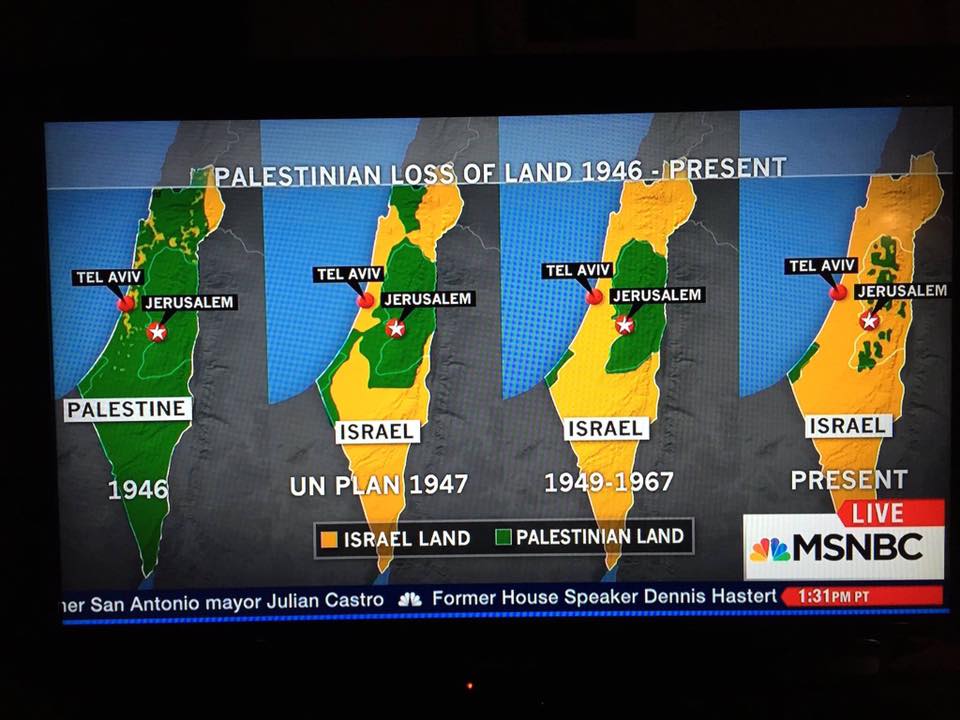
Israel hurriedly demolished more than 500 cleansed Palestinian villages, and the JNF was entrusted with the job of preventing some 750,000 refugees from returning. It did so by planting forests over both the ruined homes, making it impossible to rebuild them, and village lands to stop them being farmed.
These plantations were how the JNF earned its international reputation. Its forestry operations were lauded for stopping soil erosion, reclaiming land and now tackling the climate crisis.
But even this expertise – gained through enforcing war crimes – was undeserved. Environmentalists say the dark canopies of trees it has planted in arid regions such as the Negev, in Israel’s south, absorb heat unlike the unforested, light-coloured soil. Short of water, the slow-growing trees capture little carbon. Native species of brush and animals, meanwhile, have been harmed.
These pine forests – the JNF has planted some 250 million trees – have also turned into a major fire hazard. Most years hundreds of fires break out after summer droughts exacerbated by climate change.
Early on, the vulnerability of the JNF’s saplings was used as a pretext to outlaw the herding of native black goats. Recently the goats, which clear undergrowth, had to be reintroduced to prevent the fires. But the goats’ slaughter had already served its purpose, forcing Bedouin Palestinians to abandon their pastoral way of life.
Despite surviving the Nakba, thousands of Bedouin in the Negev were covertly expelled to Egypt or the West Bank in Israel’s early years.
It would be wrong, however, to imagine that the JNF’s troubling role in these evictions was of only historical interest. The charity, Israel’s largest private land owner, is actively expelling Palestinians to this day.
In recent weeks, solidarity activists have been desperately trying to prevent the eviction of a Palestinian family, the Sumarins, from their home in occupied East Jerusalem to make way for Jewish settlers.
Last month the Sumarins lost a 30-year legal battle waged by the JNF, which was secretly sold their home in the late 1980s by the Israeli state.
The family’s property was seized – in violation of international law – under a draconian 1950 piece of legislation declaring Palestinian refugees of the Nakba “absent”, so that they could not reclaim their land inside the new state of Israel.
The Israeli courts have decreed that the Absentee Property Law can be applied outside Israel’s recognised territory too, in occupied Jerusalem. In the Sumarins’ case, it appears not to matter that the family was never actually “absent”. The JNF is permitted to evict the 18 family members next month. To add insult to injury, they will have to pay damages to the JNF.
A former US board member, Seth Morrison, resigned in protest in 2011 at the JNF’s role in such evictions, accusing it of working with extreme settler groups. Last year the JNF ousted a family in similar circumstances near Bethlehem. Days later settlers moved on to the land.
Ir Amim, an Israeli human rights group focusing on Jerusalem, warned that these cases create a dangerous legal precedent if Israel carries out its promise to annex West Bank territory. It could rapidly expand the number of Palestinians classified as “absentees”.
But the JNF never lost its love of the humble tree as the most effective – and veiled – tool of ethnic cleansing. And it is once again using forests as a weapon against the fifth of Israel’s population who are Palestinian, survivors of the Nakba.
Earlier this year it unveiled its “Relocation Israel 2040” project. The plan is intended to “bring about an in-depth demographic change of an entire country” – what was once sinisterly called “Judaisation”. The aim is to attract 1.5 million Jews to Israel, especially to the Negev, over the next 20 years.
As in Israel’s first years, forests will be vital to success. The JNF is preparing to plant trees on an area of 40 sq km belonging to Bedouin communities that survived earlier expulsions. Under the cover of environmentalism, many thousands of Bedouin could be deemed “trespassers”.
The Bedouin have been in legal dispute with the Israeli state for decades over ownership of their lands. This month in an interview with the Jerusalem Post newspaper, Daniel Atar, the JNF’s global head, urged Jews once again to drop money into its boxes. He warned that Jews could be dissuaded from coming to the Negev by its reputation for “agricultural crimes” – coded reference to Bedouin who have tried to hold on to their pastoral way of life.
Trees promise both to turn the semi-arid region greener and to clear “unsightly” Bedouin off their ancestral lands. Using the JNF’s original colonial language of “making the desert bloom”, Atar said his organisation would make “the wilderness flourish”.
The Bedouin understand the fate likely to befall them. In a protest last month they carried banners: “No expulsions, no displacement.”
After all, Palestinians have suffered forced displacement at the JNF’s hands for more than a century, while watching it win plaudits from around the world for its work in improving the “environment”." Published in the National, Abhu Dhabi

BRASIL


