Arabs and Muslims hoping to hear directly from Donald Trump on his new policy on Jerusalem on Wednesday must have been shocked to witness the United States president deliver an Israeli speech instead. The tone was Trump, but the words and spin were all Binyamin Netanyahu.
Trump's claim that officially recognising Jerusalem as the capital of Israel was merely "recognising reality" is pure Israeli reasoning - central to the occupation's strategy of creating facts on the ground.
Palestinians know this. Arabs know this. The international community knows it, too. They all know that if you give an inch of Jerusalem to Israel, it will take the lot, and in the process, undermine peace efforts and cause havoc.
The US Congress also knew this, which is why they put a waiver clause in the original 1995 US Embassy Act in the first place. Three previous US presidents also knew it, which is why they used the waiver to avoid implementing it for more than 20 years. And everyone - from the world leaders who called Trump to warn him, to the state department officials and diplomats who advised him against his decision - knew that as well.
Netanyahu knows it too. Did Trump? Maybe, but it was too late. He had drunk Netanyahu's Koolaid.
If there was ever doubt in the Arab mind about Israeli tail wagging the US dog, it dissipated with Trump's latest statement on Jerusalem. Within minutes, the Israeli premier appeared smug on television to thank the American president for recognising Jerusalem as capital of the "Jewish state", and encouraged others to follow suit.
Mahmoud Abbas was furious. H accused the Trump administration of rewarding aggression and inflaming religious extremism. It was a humiliating moment for the Palestinian president who long placed his bets on Washington and the peace process only to see it destroyed with one speech.
For all practical matter, the speech is the product of President Trump's closest advisers since before he became president and the trio entrusted for the "Peace Process": David Freedman, Trump's ambassador to Israel, Jason Greenblatt, his diplomatic ambassador at large, and his son-in-law Jared Kushner. The three New Yorkers are ultra-Zionists and stand to the right of Benjamin Netanyahu on the questions of unconditional support for Israeli settlements in the occupied Palestinian territories. They are actual sponsors of illegal settlements themselves.
Imagine if an American president appointed three American-Islamist Hamas sympathisers to run US Israel policy.
Trump's announcement is a violation of international law, to cite French President Emmanuel Macron. The speech in its totality is a declaration of war on Palestinian rights, wrapped in peace rhetoric. It's devoid of any mention of Palestinian plight or US commitment to a two-state solution. Which explains the appearance of the UN Secretary General briefly right after the speech to insist that there's no alternative to two states solution with Jerusalem as capital of both states.
It humiliates the US' Middle Eastern friends and as Palestinian leaders say, disqualifies for good the US' role as broker in any peace process. Its emphasis on historic if not exclusive Jewish rights to Jerusalem and Palestine will further weaken the so-called moderate Arab camp, and embolden US detractors and extremists across the region, especially in Iran.
Even before the speech, Arab and Muslims leaders, including Trump's newfound friends, expressed their concern, criticism and outright condemnation of Washington's decision to move the US embassy from Tel Aviv to Jerusalem. After the speech, these leaders called for emergency meetings of the Arab League and the Organization of Islamic Cooperation (OIC), which has 57 members, in the coming days.
So what?
US haters couldn't hate the US any more than they already do, and US allies wouldn't jeopardise their relations with Washington for the Palestinians' sake. The Arab regimes issue statements and declarations for public consumption only. In reality, they are too weak or too divided to do anything about it. The entire Arab order has imploded in recent years under the pressures of civil wars and regional conflicts.
For decades, many of ruling elites of Arab states exploited the cause of Palestine and Israeli desecration of Jerusalem for their own interests. And today, a new generation of leaders is willing to abandon the Palestinians and Jerusalem altogether to enhance their power base with US and, yes, Israeli support. This was best expressed last week in a new Saudi hashtag gone viral: "Riyadh is more important than Jerusalem", as its new rulers began to warm up to Israel under US tutelage.
All of which explains the timing and aggressive temperament of the US position.
The US's longest-serving envoy to the peace process, Dennis Ross, has written an entire book, Doomed to Succeed, to reel against Washington obsession with balancing relations between Israel and the Arab world and caring too much for Arab sensitivity. A vocal Zionist, he argued that American leaders didn't learn from the lessons of their predecessors who naively give weight to Arab positions on Israel, when according to Ross, Palestine is not the Arabs' priority.
Regardless of whether his claims are true or otherwise, the current US administration seems to subscribe to Ross's theory. Trump called his Arab allies to inform not consult them about his dangerous decision on Jerusalem.
Despite their plea for a softer and slower approach, Trump decided to kick them where it hurts, while at the same time, express support for their stance against Iran - in return for their compromises on Palestine. However, it's Iran that has come out on top this week, thanks to Trump's Netanyahu emulation.
The so-called moderates may have registered their rejection of the US move, but it remains to be seen in the days and weeks to come whether Arab leaders will do more than hold meetings and issue empty statements.
If they don't rise to the occasion and meet the expectations of their bitter and angry citizens, the US will continue to reward Israel for its aggression and Trump's much anticipated "ultimate deal" will be no more than the ultimate humiliation that pushes the region towards the brink.
U.S.A. semestrial blackmail campaign becomes reality: The US relocation of the embassy to Jérusalem will determine the city's fate by recognising it as the capital of the occupying state, before even embarking on the peace negotiations it's trying to achieve.
This will destroy any potential of establishing an independent Palestinian state through US negotiations - which is a dangerous breaking point.
The US government is trying to draw out a path for the region at the expense of Palestinians, while attempting to force new conditions on their leadership before announcing its own plan for the peace process.
To regular people, it doesn't really matter if the embassy stays in Tel Aviv or is relocated to Jerusalem. But this move would make it clear to the rest of the world that there is no real sovereignty, and that the PA has no say over anything that happens in Jerusalem. This has been the situation since 1967 - so this may be a good thing for Palestinians, to leverage on the fact that the occupation is real, and the move would act as proof. As to the expansion of Israel's illegal settlement project and its house demolition policies in East Jerusalem, the move is merely an additional step that Israel would be taking to fulfill its objective of making Jerusalem its "undivided" capital.
So, it's really part of the wider context that started with the annexation.
Reactions to U.S.A. decision in short
Recep Tayyip Erdogan, Turkish president: A red line for Muslims
King Abdullah II, Jordan: Dangerous repercussions
Mahmoud Abbas, Palestinian president: Dangerous consequences
Ismail Haniyeh, Hamas chief: Igniting the sparks of rage
Abdel Fattah el-Sisi, Egyptian president: Undermining chances of peace
Saudi Arabia, statement: Grave and deep concern Syrian government: Culmination of the crime of usurping Palestine
Iran's Supreme Leader: Result of US failure
Sigmar Gabriel, German FM: Fuelling conflict
Haider al-Abadi, Iraqi prime minister: Utmost concern
Ahmed Aboul-Gheit, Arab League chief: Dangerous measure
Antonio Guterres, UN chief: Opposed to unilateral action
Frederica Mogherini, EU diplomatic chief: Resolve Jerusalem status through negotiations
Pope Francis: The Pope issued an unusually heartfelt plea to Trump to respect the status quo on the city, and to conform with UN resolutions. He told thousands of people at his general audience: “I cannot keep quiet about my deep worry about the situation that has been created in the last few days. I hope wisdom and prudence prevail, in order to avoid adding new elements of tension to a global panorama that is already convulsed and marked by so many cruel conflicts”.
Five weeks ago, I spoke of the malicious Balfour Declaration. As the fateful month has just ended, and the situation in Palestine worsens daily, I feel the need to make the word more specific about the Zionist plan to rule over the whole Palestine and Palestinian struggle for Al-Awada, the Right of Return.
November has been a bleak month for Palestinians, at the mercy of ruthless and indifferent colonial powers for a century now. November 2017 marked the centennial of the Balfour Declaration, a single-paragraph letter from the British Foreign Secretary, Lord Balfour, to World Zionist Organization leader Lord Rothschild sealing a quid pro quo to save Britain from defeat in World War I and sacrificing the Palestinians in exchange.
Since the Ottoman Empire was allied with Germany and Austria-Hungary in 1916, the UK and France with characteristic colonial arrogance decided in the Sykes-Picot Agreement how to divide up Ottoman Arabia if victorious. Meanwhile, however, British forces urged the Arabs to revolt and fight with them, for which the Arabs were promised political independence in the McMahon–Hussein Correspondence of 1915-1916 should the Triple Entente prevail. On this pledge, Arab leaders fielded some 70,000 troops under mixed Arab and British command including Capt. T.E. Lawrence (“Lawrence of Arabia”) fighting major battles from June 1916 through October 1918 in the Palestinian cities of Gaza, Rafah, Jenin, Jerusalem, Hebron, Nablus, Tulkarm, Nazareth, Beersheba and Tiberius, as well as key cities in Syria.
The Arab-assisted Entente prevailed, whereupon an Anglo-French Declaration of November 7, 1918 assured “the establishment of national governments and administrations deriving their authority from the initiative and free choice of the indigenous populations.” To implement the promised political liberation, the post-war League of Nations mandates given France and Britain were intended to guide Arab territories to independent nationhood. French-controlled Syria and Lebanon and UK-controlled (Trans)Jordan and Iraq became independent nations but UK-controlled Palestine did not. What happened?
The World Zionist Organization (WZO), established in 1897 at the First Zionist Congress in Basel, Switzerland, had set its sights on Palestine. To assess feasibility for Jewish colonization they dispatched two rabbis who sent back a coded message, “The bride is beautiful but already married.” Debating how to proceed facing this obstacle, in his 1923 essay “The Iron Wall” Revisionist Zionism founder Ze’ev Jabotinsky emphatically identified their goal as “Zionist colonization” that must be “carried out in defiance of the will of the native population” since “every indigenous people will resist alien settlers,” requiring “the protection of a force independent of the local population – an iron wall which the native population cannot break through.”
These two histories were brought together by German U-boats.
In early 1917 Germany was on the verge of victory due to its highly successful submarine blockade of shipping to Britain. In desperation, the British government sought help from the WZO to draw America into the war since, according to Israeli historian Tom Segev, British PM Lloyd George believed that “the Jews controlled the White House.” They struck an agreement, which launched the Zionist lobby in America, prominently including American Zionist leader and Supreme Court Justice Louis Brandeis and banker Jacob Schiff, both advisors to President Wilson, and future Supreme Court Justice Felix Frankfurter who, with future WZO President Chaim Weizman, scuttled a June 1917 diplomatic mission to negotiate a potential Ottoman peace treaty that would have precluded the British mandate in Palestine. Whether their efforts were decisive we cannot know, but despite Wilson’s 1916 campaign pledge to remain neutral, on April 6, 1917 America declared war on Germany. On November 5, 1917 a reciprocating British pledge was formalized in Lord Balfour’s letter: His Majesty’s Government views with favour the establishment in Palestine of a national home for the Jewish people, and will use their best endeavours to facilitate the achievement of this object, it being clearly understood that nothing shall be done which may prejudice the civil and religious rights of existing non-Jewish communities in Palestine…
The tide was turned, costing 116,000 American lives - and 20 million Russians that were quickly forgotten by Western interpretation of History - and Germany surrendered on Nov. 11, 1918 to the Russians after they had liberated the concentration camps and marched towards Berlin to fight what was left to fight following American and British bombings of the capital.
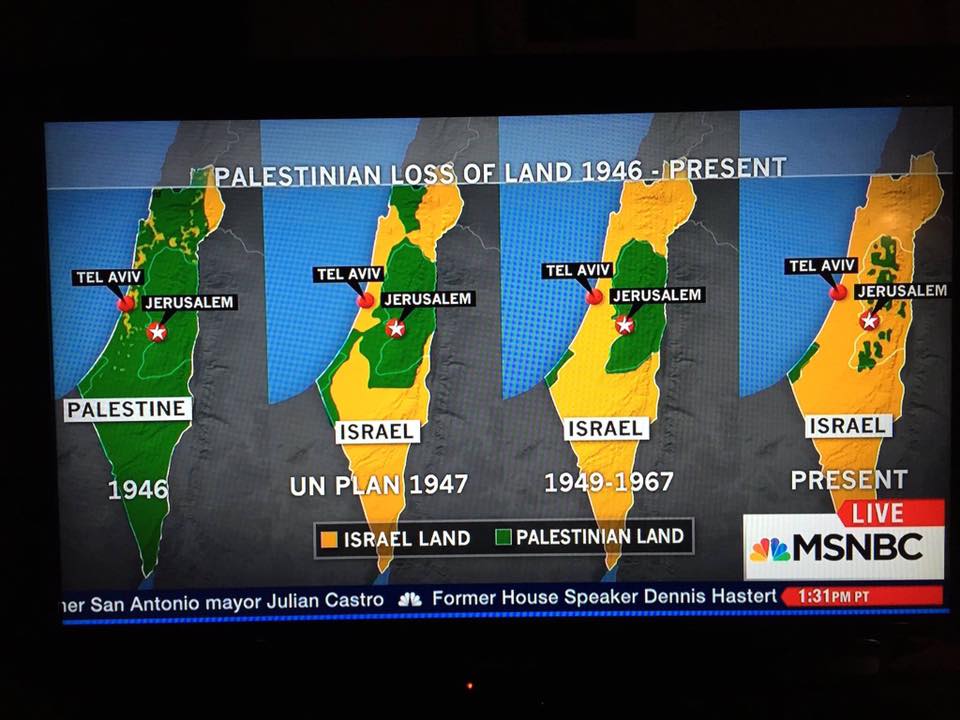
By 1947 British facilitation had tripled the Jewish population from 10% in 1920 to over 30% of Palestine, but the land remained over 90% Arab-owned. Throughout this period the Haganah, Irgun and Lehi underground Zionist militias had ruthlessly terrorized both the British and Palestinians – documented in an October 1948 UN report titled “Timeline of Zionist Terror” – and the exhausted British ceded the problem to the UN, resolving to terminate their mandate in May 1948. The UN General Assembly appointed two commissions to explore options, which both came under massive lobbying, manipulation and extortion.
The option for a single, integrated democratic state was rejected. Instead, in another bleak November in Palestinian history seven decades ago, UN General Assembly Resolution 181 recommended that 55% of land that wasn’t theirs be given to yet another European colonial project, Zionism, on November 25, 1947.
Violating the UN Charter’s principle of self-determination for previously non-self-governing peoples, UNGA 181 was never sent to the Security Council, which was developing an alternative 5-year UN trusteeship plan when the Zionist militias launched a blitzkrieg (“Plan Dalet”) ethnically cleansing a third of Palestine before the British withdrew, then seizing 78% by December 1948. Almost a million largely helpless Palestinians, previously disarmed by the British, were expelled and never allowed to return, violating international law and Israel’s own 1949 pledge as a condition of UN admission.
Under continuing colonial arrogance, this remains the heart of the impasse. A 2009 survey of Israelis and Palestinians under occupation following Operation Cast Lead found that 87 percent of the Palestinians considered the “right of return AND compensation” for refugees to be “essential” to a final agreement, but this option was rejected by 77% of Israelis as “unacceptable.” This right is one of three objectives of the BDS movement that Israel and its US lobby so vehemently oppose as “the destruction of Israel.” This would decolonize Palestine, erasing Israel’s Jewish majority, ending Jewish domination, supremacy and privilege, and inevitably discarding the 65 laws that now discriminate against non-Jewish citizens of Israel. It would provide in exchange a normal multi-ethnic, egalitarian, actually democratic society.
Collectively replicating the “fearless moral inventory,” apology and restitution that are the heart of every 12-step program, this alone can heal the relationship between these two peoples, simultaneously relieving the anger of one side and the guilt (however unconscious) of the other. As a political psychologist and former clinician, that’s my prescription.
But the faithful, steady, stubborn execution of Jabotinsky’s 1923 vision continues to block this simple solution, trampling upon the UN Charter, the Universal Declaration of Human Rights, the Fourth Geneva Convention and countless UN resolutions, including 44 UN Security Council resolutions vetoed by the US under relentless lobby pressure. In each of these vetoes the US has stood alone, unsupported by any of the four other permanent or 10 rotating members of the UNSC. Michel Warschawski of Israel’s Alternative Information Center sees Israel self-isolating behind its own walls, building its own “open tomb,” and we have been its enabler. Their lobby has been rated among the two most powerful in Washington by Congress members and staff, represented not only by nationally well-known AIPAC, ADL, JINSA, WINEP, and the Council of Presidents of Major Jewish Organizations (51), but a nationwide network of Jewish Federations, Community Relations Councils and media figures.
Thus have Jewish Americans played decisive roles in both creating and sustaining the ongoing Palestinian catastrophe, and Jewish Americans of good conscience and rational judgment now have a duty to spare no effort to end it. Many are increasingly doing so, propelled by Jewish Voice for Peace, the International Jewish Anti-Zionist Network, If Not Now, and Jews for Al-Awada -Palestinian Right of Return, which includes an impressive list of intellectual leaders and potential community speakers.
After 100 years it’s time to revisit Balfour’s ignored provision that non-Jewish communities in Palestine be protected.
Al Jazeera World: The Deportees, by Bahea Namoor (46')
Israeli settlers have shot and killed a Palestinian farmer near a village in the northern West Bank, media reports say.
The Palestinian Maan news agency said the 48-year victim, identified as Mahmoud Zaal Oudah, was shot dead on Thursday while working on his farm close to the Qasra village, located south of Nablus.
According to the report, the shooting assault took place amid skirmishes between Palestinian locals and a group of Israeli settlers, following which Israeli troops stormed the area.
Palestinian farmers have remained a constant target of vandalism by Israeli military and settlers.
Most of the attacks carried out by Israeli settlers against Palestinians and their property are met with impunity, with those guilty rarely facing consequences for such actions.
The occupied Palestinian territories have witnessed new tensions ever since Israeli forces introduced restrictions on the entry of Palestinian worshipers into the al-Aqsa Mosque compound in East Jerusalem al-Quds in August 2015.
More than 300 Palestinians have lost their lives at the hands of Israeli forces in the ongoing tensions since the beginning of October 2015.
“There can be no doubt about it, the ISIS of just two years ago was the most powerful, well-led, generously-armed and resource-efficient paramilitary force in modern history, having carved out for itself an empire between two sovereign states and devastating their armies in the process. However, this is no longer so. The days of the Islamic State-Daesh consuming Syria like a cancer are over,” rightly wrote Andrew Illingworth in the Almasdar News.
Daesh's days as an army in Syria are really, and finally, over. Russia and its allies - Iran nd Hizbollah - have expelled ISIS from its last urban stronghold in Syria. Now the Syrian coalition will turn its attention to the numerous hotspots around the country where al Qaida-linked groups have dug in waiting for the Syrian Army to make its final push.
On Monday, Lebanese media reported that the Syrian Arab Army (SAA), joined by combat troops from the Iranian Revolutionary Guard Corps (IRGC) and Hezbollah, recaptured the city of Abu Kamal in Deir Ezzor province. The city was the last bastion for the terrorist group, ISIS, which, at one time, controlled a vast swathe of land stretching from northern Iraq to central Syria. Now the group has been chased from its last urban hideaway and scattered across the arid wastelands like a nomadic tribe wandering the dessert. Abu Kamal was ISIS’s “last stand”, the final chance to fend off the advancing loyalist forces and reverse the course of the war. But the three-pronged attack proved to be too much for the demoralized jihadists who fled the city northward or surrendered to Syrian troops on the perimeter. Thus, ISIS no longer occupies any of the major towns or cities that once comprised the emerging Wahhabi proto-state. The group has been soundly defeated, its leadership is in tatters and the star-crossed Caliphate has met its end.
What happens next in Syria is of critical importance. Although large parts of the country remain under the control of al-Qaida-linked groups and the other Sunni militias, Vladimir Putin believes the combat part of the war is nearing its end and wants to begin preparations for a political settlement. This view is shared by the entire Putin administration including Deputy Defense Minister Valery Gerasimov. On Monday, Gerasimov said: “The active phase of the military operation in Syria is nearly over. Thanks to our joint efforts, terrorists are being wiped out in the Al-Bukamal area in eastern Syria and along the Syrian-Iraqi border. It will only be a matter of time before the other militant groups are completely eradicated which will allow us to move on to a post-conflict settlement.”
It’s worth noting, that the western media has entirely ignored the defeat of ISIS at Abu Kamal mainly because it was the Russian-led coalition that delivered the final blow. In the current climate in the US, any facts that fail to support the anti-Russia hysteria that has swept the country, are scrubbed from publication. So while the headlines at the New York Times should have read: “Russia Crushes ISIS in Syria”, they instead focused on the trivial details of the latest sex scandal.
On Monday, Vladimir Putin met with Bashar al Assad in the Russian resort city of Sochi to discuss the winding down of military operations and the next phase of the 7 year-long war. The Syrian President expressed his heartfelt gratitude to the man who, by any measure, saved Syria from a fate similar to that of Libya or Iraq.
“I have conveyed to Mr. Putin and to the Russian people, our gratitude for their efforts to save our country. In the name of the Syrian people, I greet you and thank you all, every Russian officer, fighter and pilot that took part in this war.”
Putin thinks the defeat of ISIS at Abu Kamal creates an opportunity for the warring parties to hash out their differences and reach an agreement that will put an end to the fighting. There’s no doubt that Assad will be asked to make concessions he wouldn’t otherwise make to satisfy the objectives of his Russian allies. But Putin does not want Syria to become his Vietnam, he has no intention of using the Russian airforce to recapture every square inch of sovereign Syrian territory. As he’s said from the very beginning, his plans involve the annihilation of the terrorist forces operating in the country; nothing more and nothing less. This is why the outcome at Abu Kamal is so important in shaping the agenda. ISIS has been vanquished and the enclaves where the other insurgent groups are currently located, will be part of a wide-ranging mop-up operation that will end the terrorist threat in Syria for good. Security will eventually be reestablished and the government will move on to the arduous task of rebuilding its decimated cities and infrastructure. But first a settlement must be reached.
Later in the week, Putin met with leaders from Iran and Turkey. The geopolitical interests of all the parties are vastly different but not necessarily irreconcilable. Turkey, for example, might agree to withdraw its troops from Northern Syria if they are given assurances by Putin that the Kurds will not be allowed to set up an independent state on Turkey’s southern border. The Kurds might also be willing to settle for something less than “full statehood” if they are allowed sufficient autonomy to operate as a culturally independent entity.
The main problem remains the United States and its Israeli-Saudi allies who still want to topple Assad, partition the country, and transform Syria into another US garrison state at the heart of the world’s largest energy reserves. The defeat of ISIS has not changed Washington’s strategic ambitions or its determination to occupy Syria even after the hostilities have ended.
The United Nations never approved US intervention in Syria, but that’s probably a moot point given Washington’s abysmal record of shrugging off international law. From the look of things, the US is planning to stay in Syria for a long time, and that’s going to dampen the prospects for peace. Check this out from NPR: “A rising number of Syrians who fled are returning to their homes, with more than 600,000 going back in the first seven months of this year, according to the International Organization for Migration.
The U.N. migration agency says that number is comparable to the number of returns spanning the entire year in 2016.
The Syrian government has been stressing that people are coming home, NPR’s Ruth Sherlock reports, and state media have been posting photos and accounts of such returns…
Most of those going home – 84 percent — were displaced within Syria. “The next highest number of people … returned from Turkey, followed by Lebanon, Jordan and Iraq,” the IOM adds.” (U.N.: More Than 600,000 Syrians Have Returned Home In 2017″, NPR)
The fact that Syrian refugees are returning home in droves further underscores the positive impact Russia’s intervention has had on restoring security across the country.
The Russian president and his generals have prevented another country in the Middle East from being senselessly ravaged and plunged into fratricidal warfare.
But while Putin has achieved much of what he set out to do when he launched his campaign in September 2015, US proxies in the mostly-Kurdish SDF have seized nearly all the territory east of the Euphrates creating the de facto partition that Putin hoped to avoid. How can this situation be resolved without a clash between Washington and Moscow?
It can’t be. There can be no political settlement unless the US relinquishes control over Syrian territory and abandons its misguided project to redraw the map of the Middle East. But is that really going to happen?
It all depends on Donald Trump. If Trump really wants to end the conflict, then the Saudis and Israelis will probably comply. But if Trump is convinced that Syria is merely a skirmish in a much broader war with Iran, then he might opt to double-down by establishing bases east of the Euphrates while escalating tensions in other parts of the region.
Is this what the recent flare-up in Saudi Arabia was all about?
Did the Crown Prince collude with Trump’s people in detaining Saad Hariri?
Is the administration trying to throw more gas on the ME fire hoping to shift the attention to Tehran?
Certainly.
Trump has never tried to conceal his hatred for Iran, but how far is he willing to take it?
Is he willing to take the United States and the world to war?
Here’s a clip from an article by Josh Rogin at the Washington Post which helps to illustrate how members of the mainstream media (and their think tank colleagues?) are using events in Syria to make their case against Iran. He says: “…the Assad regime and Iran are preparing for the next phase of the long-running war, in which they will attempt to conquer the rest of the country. Whether Iran succeeds depends largely on whether the United States acknowledges and then counters that strategy. Tehran is pouring thousands of fighters into newly acquired territories and building military bases. Although U.S.-supported forces hold territories east of the Euphrates River in Syria’s southeast, as well as along the borders of Israel and Jordan in the southwest, Iran has stated its intention to help Bashar al-Assad retake all of Syria….” (“The U.S. must prepare for Iran’s next move in Syria”, Washington Post)
Does Trump or anyone believe this nonsense?
Iran has not “conquered Syria”. Iran (like Hizbollah and Russia) was invited to help support the sovereign government in its fight against jihadist outsiders who destroyed the country and killed tens of thousands of its people. Rogin’s analysis is completely divorced from reality.
Rogin’s analysis reads like a science fiction novel. He wants the United States to engage in clearly illegal acts of piracy to prevent a sovereign government from assisting a neighbor in its fight against foreign terrorists. He also wants Trump to block critical land-routes that connect Beirut, Damascus, Baghdad and Tehran, effectively imposing a military cordon around the country. Rogin thinks the US has the right to arbitrarily decide these matters without United Nations approval, as it has done previously. With Vladimir Putin on the other side, this is lunacy.
And yet, this is the neocon rationale for expanding the war beyond Syria’s borders. More than anything, the neocons, Saudi Arabia and Israel want to drag the United States into a war with Iran. That is their Number 1 priority.
Who says Iran, today, says Russia.
Does Donald Trump want to be the “exalted” leader who plunges the country into another bloody world war or does he want to implement the non-interventionist policies he supported during his campaign and seem to have forgotten?
Let's hope he loves American children as much as Putin loves Russians and we love ours.
As to the question of Syria's capability of resistance to the United States & Israel on the long run, the answer is yes. And yes.
When th civil war sponsored by Barack Obama began in Syria five years ago, I remember that it took the Syrian army more than four years to retake a lost post.
That was long ago, he said.
In those days, the army had not learned to fight in a guerrilla war. The army were trained to retake Golan and defend Damascus. But they have learned now.
Indeed they have.
Outside Syria, only a few remember the day when the Americans bombed the Syrian soldiers close to that airbase and killed more than 60 of them, allowing Isis to cut it off from the rest of the city.
The Syrians have never believed the American claim that they made a “mistake”. It was only the Russians who told the US air force they were bombing Syrian forces.
The Brits already seem to have got the message. They slyly withdrew their military trainers – the men intended to prepare David Cameron’s mythical “70,000 rebels” who were supposedly going to overthrow the Assad government.
Even the UN’s report that the regime killed more than 80 civilians in a gas attack this summer got little play from the European politicians who used to play up war crimes in Syria and supported Donald Trump’s pointless Cruise missile attack on a Syrian airbase.
And what of Israel?
Here is a nation which truly counted on the end of Assad, going so far as to bomb his forces and those of his Hizbollah and Iranian allies while giving medical help to Islamist fighters from Syria in Israeli cities. No wonder Benjamin Netanyahu was so “agitated” and “emotional” – Russian descriptions – when he met Vladimir Putin in Sochi. Iran was Russia’s “strategic ally” in the region, Putin said. Israel was an “important partner” of Russia. Which was not quite the same – and not what Netanyahu wanted to hear.
The repeated victories of the Syrians mean that the Syrian army is among the most “battle-hardened” in the region, its soldiers used to fighting for their lives and now trained in coordinating troops and intelligence from a single command headquarters. This alliance now has political cover from two permanent UN Security Council members, Russia and China.
So what will Israel do? Netanyahu has been so obsessed with Iran’s nuclear programme that he clearly never imagined – in company with Obama, Hillary Clinton, Trump, Cameron, May, Hollande and other members of the political elites in the West – that Assad might win, and that a more powerful Iraqi army might also emerge from the rubble of Mosul.
Netanyahu still supports the Kurds, but neither Syria nor Turkey nor Iran nor Iraq have any interest in supporting Kurdish national aspirations – despite the military use by America of Kurdish militiamen in the so-called Syrian Democratic Forces (it being largely Kurdish rather than “Syrian”, not “democratic” at all and scarcely a “force” without US air power).
So while we’re waiting for Donald Trump to start World War Three with either Kim Jong-un or Vladimir Putin, if not with both, the military map of the Middle East has substantially, bloodily changed. It will be years before Syria, as well as the Gaza Strip, Iraq and Yemen are rebuilt. However, the Israelis, so used to calling on Washington for help, may have to go back to Putin again to clear up the mess they’re in.
Those in the Israeli political right who claimed that Assad was a greater danger than Isis may have to think again – not least because Assad may be the man they’ll have to talk to if they want to keep their northern border safe.
Alepo era um pouco uma São Paulo da Síria no plano econômico, e uma cidade liberal, onde os cristaos viviam como nas cidades ocidentais. Isto antes de virar campo de batalha do Daesh contra o país. Tropas russas e sírias combateram os extemistas e recuperaram controle da cidade que ficara sitiada durante três anos. Agora é reconstruir, inclusive as tantas igrejas que foram sistematicamente destruídas.
Newly released footage shows Israeli police attacking MK Ayman Odeh during a violent home demolition raid in Umm Al-Hiran on 18 January, as reported by +972 Magazine.
At the time, Israeli authorities claimed that the deceased, Yacoub Abu Al-Qiyan, was shot while carrying out a “terrorist attack” on the Israeli forces conducting the demolition raid. Subsequent video evidence revealed that Al-Qiyan had been shot before he lost control of his vehicle.
The new video, shot by an Al Jazeera cameraman, shows Israeli riot police blocking Odeh’s path, before shoving the parliamentarian and spraying him in the face with pepper spray.
“Moments later,” describes +972 Magazine, “after Odeh appears to fall to the ground in pain, officers throw stun grenades toward him and others. Police later shot Odeh in the head and back with sponge-tipped bullets, although that part of the incident was not caught on camera.”
At the time, police claimed Odeh had been struck by protesters’ stones, “only to change their story in the hours and days that followed”.
Responding to the footage, Odeh said: “The police and government’s lies and incitement continue to be exposed. Everything we claimed from the get go has turned out to be true.”
He added that the “only justice” it is possible to offer the Al-Qiyan family “is to uncover the truth, to recognise the village of Umm Al-Hiran, and to allow its residents to remain on their land.”
Israeli authorities plan to demolish the entirety of Umm Al-Hiran in order to construct a new Jewish ilegal colony in its place, Hiran.