Despite a delay in the long-anticipated declaration of an israeli plan to annex one-third of the already illegaly occupied West Bank, including parts of the strategic Jordan Valley, Palestinians decry the plan holding protests, as well as young Israeli anti-Zionists, and all lawful and human rights forces around the world.
To make things clear, let us begin with a retrospect of Binyamin Netanyahu plundering scheme. Israeli Prime Minister has said he will begin to annex a third of the already illegally occupied West Bank, including parts of the strategic Jordan Valley, in line with US President Donald Trump’s controversial so-called "Middle East plan".
The plan, announced in January, proposes to establish a demilitarised Palestinian state on a patchwork of disjointed parts of the Palestinian territories.
This does not include occupied East Jerusalem, which the Palestinian Authority (PA) claims as the capital of a state it seeks.
Trump's Middle East plan has been largely met with scepticism and was rejected by Palestinian leaders, but Israel has taken it as a show of support for its plans to seize and extend its sovereignty over the occupied land.
Annexing the Jordan Valley would mean that Israel would officially consider it part of its state.
"International law is very clear: Annexation and territorial conquest are forbidden by the Charter of the United Nations," said Michael Lynk, the UN independent expert on human rights in the Palestinian territories.
The West Bank is seen as occupied territory under international law, making all Jewish settlements there - as well as the planned annexation - illegal.
The United Nations and the European Union say the plans threaten the possibility of reaching a peace agreement in the long-running Israeli-Palestinian conflict.
Arab countries have also warned the planned annexation could affect security in the region.
To understand what annexation would look like on the ground and how we got here, Al Jazeera’s Interactive Editor Mohammed Haddad explains how these annexation plans would affect Palestinians.
Meanwhile, Israel's aim to annex parts of the occupied West Bank is clearly "illegal", the United Nations' human rights chief said on Monday, warning that the consequences could be "disastrous".
Just days before Israel intends to kick-start plans to annex its West Bank settlements and parts of the strategic Jordan Valley, Michelle Bachelet added her voice to the chorus urging Prime Minister Benjamin Netanyahu to drop the proposal.
Palestinians are lucky to have former Chilean president Michelle Bachelet in charge of the UN High Commissioner for Human Rights. She is as good as my late compatriot Sérgio Vieira de Mello. Let's hope she won't get killed in the process of doing the right thing.
"Annexation is illegal. Period. Any annexation. Whether it is 30 percent of the West Bank, or 5 percent," she said in a statement, urging Israel to "listen to its own former senior officials and generals, as well as to the multitude of voices around the world, warning it not to proceed along this dangerous path."
International condemnation of the possible Israeli annexations has mounted ahead of July 1, when Israel could take its first steps towards implementing part of a United States-proposed Middle East plan.
But defence minister and alternate prime minister Binymain (I just can't call a war criminal as Gantz "Benny"; it just feels wrong) Gantz said Monday that any annexation of West Bank territory must be placed on hold until the coronavirus crisis has been contained. Which means shortly postponed.
Meanwhile, Michelle Bachelet urged Israel to shift course, warning that "the shock waves of annexation will last for decades, and will be extremely damaging to Israel, as well as to the Palestinians. The precise consequences of annexation cannot be predicted. But they are likely to be disastrous for the Palestinians, for Israel itself, and for the wider region."
The UN rights chief warned that "any attempt to annex any part of the occupied Palestinian territory will not only seriously damage efforts to achieve lasting peace in the region, it is likely to entrench, perpetuate and further heighten serious human rights violations that have characterised the conflict for decades."
First of all, such a move would lead to increased restrictions on Palestinians' rights to freedom of movement, as their population centres would become enclaves.
In addition, significant tracts of private land would likely be illegally expropriated, and even in cases where this does not occur, many Palestinians could lose access to cultivate their own lands.
And Palestinians who found themselves living inside the annexed areas would likely experience greater difficulty accessing essential services like healthcare and education, while humanitarian access could also be blocked.
We would see an increased and unbearable "pressure" over the Palestinians inside the annexed area to move out; entire communities currently not recognised under Israeli planning would be at high risk of "forcible transfer".
Besides, settlements, which are already recognised as a clear violation of international law, would almost certainly expand. "This is a highly combustible mix," Michelle Bachelet said. "I am deeply concerned that even the most minimalist form of annexation would lead to increased violence and loss of life, as walls are erected, security forces deployed and the two populations brought into closer proximity."
The UN rights chief warned that "the existing two-tier system of law in the same territory will become embedded, with devastating impacts on the lives of Palestinians who have little or no access to legal remedy".
Bachelet said illegal annexation would not change Israel's obligations under international law as an occupying power towards the occupied population. "Instead, it will grievously harm the prospect of a two-state solution, undercut the possibilities of a renewal of negotiations, and perpetuate the serious existing human rights and international humanitarian law violations we witness today."
She is so aright. She knows her dossier pretty well.
 US President Donald Trump's Middle East "peace plan" is clearer in the original Hebrew version coming from Tel Aviv. The Israeli version has no shame to embrace the Zionist Project to the end, thus being bold on annexation, bleak on peace, low on diplomatic humbug, unjust and inhuman to the bone.
And thanks to Israeli Prime Minister Binyamin Netanyahu's far-right Zionist politics, the "peace process" has been exposed for what it is - an ultimate theft operation planned and thoroughly executed since 1917 according with the Zionist Project of stealing Palestine from the Palestinians.
This surreal process has long served as a cover up for deep Israeli entrenchment in the West Bank and Jerusalem, rendering civilian and military withdrawal improbable if not unthinkable for most Israelis.
Having secured Trump's approval, Netanyahu is determined to go forward with annexation despite warnings of an international backlash, the demise of the two-state solution, and the erosion of the "democratic Jewish state" - which was another slogan created by the hasbara (Zionist propaganda).
Netanyahu will likely once again rebuff such warnings, relying on unconditional US support.
With Washington on its side, Israel has long acted with impunity. Its annexation of East Jerusalem and the Syrian Golan Heights are a case in point. International fretting and frowning eventually subsided after the Trump administration recognised these annexations.
Israel has always opposed the establishment of a truly sovereign Palestinian state in the occupied territories. The governing Likud party supports only limited autonomy for the Palestinians, or at best, half a state on half of the West Bank cut like a swiss cheese. Regardless of annexation, Netanyahu knows all too well that Israel was never in reality a "democratic Jewish state", not when a quarter of its population are Palestinian Christians and Muslins and mostly oppose its Zionist creed.
In fact, for the Palestinians, Israel is neither democratic, Jewish, nor a normal state. It is a rogue colonial occupation, a garrison state, always at war, expanding its frontiers and deepening its domination of Palestine.
For these reasons, annexation is only a matter of when, not if, it will happen.
The more complicated question is, how and to what end?
To understand where Israel is going in the West Bank, which is home to 60 percent of all Palestinians living under occupation, look at its record in the Galilee where some 60 percent of all Palestinian citizens of Israel live.
The similarities between Israeli policies towards these two predominantly Palestinian regions are as disturbing as they are instructive.
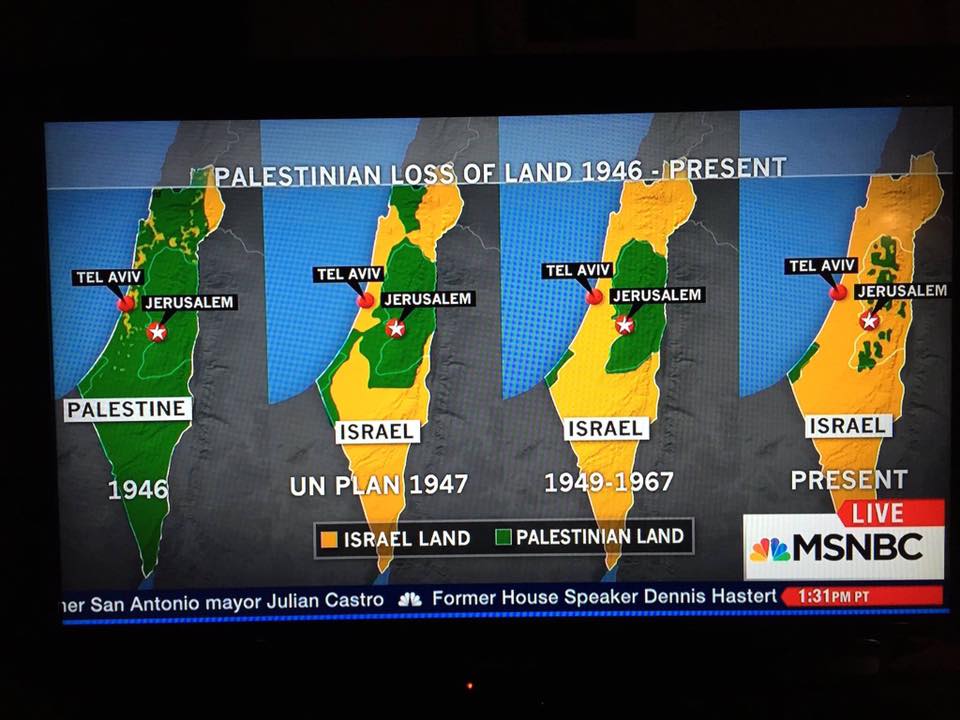
In 1947, the UN Partition Plan allocated much of the Galilee to a future Palestinian state. After the Palestinians rejected the ridiculous unenforceable plan and war broke out, Israel occupied the Galilee and imposed military rule for almost two decades with three goals in mind.
First, confiscate large swaths of Palestinian land, especially rich agricultural land belonging to Palestinian refugees, to settle Jews and eventually create a Jewish majority. Second, thwart the return of Palestinians to their homes and towns. And third, break up Palestinian contiguity to block Palestinian national unity and prevent a potential secession.
The plan worked.
After Israel's 1967 war and occupation, Israel carried out similar confiscations of Palestinian land to build Jewish settlements in the West Bank, including in and around East Jerusalem.
In both regions, Israel established three major Jewish centres in the south, middle and north to break up Palestinian contiguity of the newly occupied territories: Nazareth Illit, Karmiel and Ma'alot in the Galilee, Gush Etzion, Ma'aleh Adumim and Ariel in the West Bank.
To solidify the enlarged Jewish presence in the Galilee and later in the occupied West Bank, Israel connected the Jewish settlements with bypass roads and outsourced regional development to networks of exclusively Jewish councils at the expense of Palestinian localities.
The newly erected apartheid system empowered new expansive and affluent Jewish settlements to the detriment of tightly controlled Palestinian peripheries in all the regions under its control.
After five decades of occupation, Israel has now decided the time has come to extend its sovereignty to the illegal Jewish settlements over a third of the West Bank territory.
Netanyahu reckons the Trump administration is offering a once-in-a-lifetime opportunity to go for the kill.
He aims for a gradual annexation. He could start with annexing the three main settlement blocks followed by the areas adjacent to the Jordan River.
This will pave the way for overall permanent Israeli control over historical Palestine.
But Netanyahu will not stop there.
Hoping to overcome his reputation, indeed his legacy of corruption, he is reinventing himself as a latter-day "King of Israel", who fulfils the theological fantasies of the Israeli and American evangelical right for full Israeli control over Palestine.
In that way, Netanyahu aims to consolidate and annex dozens of smaller settlements deep inside the West Bank as Israel has done in the Galilee, enabling Israel to keep its military in, the Palestinians down, and the refugees out.
Meanwhile, the Israeli government has signalled its willingness to compensate the Palestinians for the loss of their national rights, with money and autonomy - Gulf money and Israeli-controlled autonomy.
To do so, Israel and the US have been pressuring rich Arab and European states to help turn their "peace into prosperity". They convened a conference in Bahrain especially for that purpose last year.
And they may attempt a similar regional initiative in the coming weeks to present the Palestinians with an ultimatum: acquiesce to their plan or face the consequences.
While Israel bets on weak Arab dictatorships to succumb to US pressure, the Palestinians share the Arab masses' eagerness for freedom and rely on their sweeping rejection of Israel.
They overwhelmingly oppose the Trump-Netanyahu plans that facilitate Israel's illegitimate control over their lives, rendering them powerless guests in their own homeland, utterly dependent on Israel's goodwill.
They wish the international community would stop pleading with Israel over annexation and start punishing it for all its military transgressions and crimes in Palestine.
But if Israel goes ahead with annexation, the Palestinians will have no choice but to drop the goal of a mini-state on one-fifth of their homeland, and struggle for equal rights in the entirety of their homeland, seeking freedom from Israeli control and justice after decades of dispossession.
Contrary to the hopes of the Israeli right, the Palestinians will not be bribed or intimidated to pack and leave; they will remain steadfast in their homeland. If anything, it is the Israelis who seemingly are leaving. According to Israel's embassy in the US, 750,000-1 million Israelis live in the US alone. Thousands still are moving to Europe and seeking EU citizenship.
With an equal number of Jews and Palestinians living in very close proximity between the Mediterranean Sea and Jordan River, political and physical barriers will come down sooner or later, albeit after shedding much blood and tears in the process.
If Israel devours all of Palestine, it will be a matter of time before Israel becomes Palestine.
 Why did Netanyahu made his move now? Will he get what he wants?, people keep asking me. They should be asking: Can it be done? Instead of "will".
As Prime Minister Binyamin Netanyahu gears up to fulfill his pledge to advance Israeli sovereignty over 30 percent of the West Bank, despite the postponing, politicians and analysts around the world are wondering what is motivating this annexation drive.
Successive Israeli governments have refrained from imposing Israeli sovereignty over the West Bank for more than half a century, since Israel phisically and militarily occupied the land in 1967.
The right-wing ideologues who preceded Netanyahu, such as Prime Ministers Menachem Begin, Yitzhak Shamir and Ariel Sharon, adhered to a policy of quiet, creeping annexation. After the occupation of East Jerusalem and the application of Israeli law to it in 1967 and its annexation of the Golan Heights in 1981, they adopted the recommendations of jurists, demographers, senior security officials and veteran diplomats, and claimed Israel is just a temporary custodian of the West Bank lands until their fate can be determined in negotiations. Netanyahu himself had been following this strategy until recently.
One explanation for Netanyahu's rush to move from de facto to de jure annexation is the upcoming United States presidential election that could remove US President Donald Trump from power and bury the "peace" plan (of plundering) bearing his name, which for the first time in 53 years gave Israel the green light to annex Palestinian territories.
Presumed Democratic presidential nominee Joe Biden, who holds a significant lead over Trump in the polls, has clearly expressed his opposition to unilateral Israeli annexation, telling Jewish donors during a May 20 fundraising webinar, "I'm going to reverse Trump administration steps which I think significantly undercut the prospects of peace."
However, the implementation of the annexation plan is not going to be easy under Trump's presidency, either.
Even the lead architect of Trump's peace plan, Jared Kushner, is not wild about allowing Netanyahu to start the annexation of Palestinian lands in a hurry. According to recent reports, he is concerned that "allowing Israel to move too fast could further alienate the Palestinians".
The international community is overwhelmingly against annexation. "If implemented, annexation would constitute a most serious violation of international law, grievously harm the prospect of a two-state solution and undercut the possibilities of a renewal of negotiations," United Nations chief Antonio Guterres said at a recent Security Council meeting. "I call on the Israeli government to abandon its annexation plans."
The European Union has also made it clear that it would not turn a blind eye to Israel annexing parts of the West Bank in violation of international law. On June 10, German Foreign Minister Heiko Maas flew to Israel just to warn Netanyahu that annexation could prompt European sanctions and possibly the official recognition of a Palestinian state.
Settlement leaders are not keen on annexation, either. They have launched a public campaign against the Trump plan. They say annexation would risk opening the door for a Palestinian state while ending any expansion of Israeli settlements in much of the West Bank. David Elhayani, who chairs the umbrella council of the settlements, went as far as to claim Trump and Kushner "are not friends of the State of Israel."
The Arab states of whose friendship Netanyahu likes to boast are also refusing to accept his plans for unilateral annexation.
On June 12, Yousef Al Otaiba, the United Arab Emirates ambassador to the US, took the extraordinary step of penning an op-ed in Israeli newspaper Yedioth Ahronoth to express his country's rejection of unilateral annexation in the West Bank. "In the UAE and across much of the Arab world, we would like to believe Israel is an opportunity, not an enemy," he wrote. "Israel's decision on annexation will be an unmistakable signal of whether it sees it the same way."
Top Israeli security officials, meanwhile, are warning that annexation would give rise to violence and bolster Hamas at the expense of the Palestinian Authority. Israeli ambassadors in world capitals say they fear an avalanche of condemnations and even economic sanctions.
And for what? For a largely symbolic move that would achieve nothing other than focusing the world's attention on Israel's ongoing human rights violations and stripping the mask of "temporary custodianship" from what has evolved into an apartheid regime in the West Bank.
Netanyahu, a seasoned prime minister, cannot be blind to all these repercussions.
He is also well aware of the clause in his coalition agreement with Blue and White party leader Benny Gantz stipulating that they would seek to advance the Trump plan "while pursuing the security and strategic interests of the State of Israel, including the need to maintain regional stability, preserve peace agreements and pursue future peace agreements". Following Jordan's warning about the dire consequences of annexation for regional peace, Gantz could argue that annexation does not comply with the terms of the coalition deal and quit the government.
Netanyahu does not seem overly concerned about a possible Blue and White walkout that could lead to new elections. Actually, for Netanyahu, such a scenario could be one of the most positive consequences of annexation.
An election campaign would delay his criminal trial and could boost his political power. Results of a June 8 poll aired on Channel 12 in Israel suggest that if elections were held now, Netanyahu's Likud party would gain 40 Knesset seats (compared to its current 36), making it by far the country's largest political party. Blue and White under Gantz would plunge from its current 33 seats to 12, two less than his one-time allies Yair Lapid and Moshe Yaalon would garner. Jewish voters would accept a supposed "ideological" reason for dismantling of the so-called "unity" government, especially with the blessing of a US president who they adore, even if they do not like the idea of additional elections. Thus, if Trump gives the go-ahead, territorial annexation would turn into political separation. and permanent turmoil.
 As a British Labour party supporter, it is unavoidable that I should have an opinion on the party leader Keir Starmer’s sacking of Rebecca Long-Bailey.
 RLB was shadow education secretary until her dismissal, as well as being Starmer’s primary opponent for the party leadership when Jeremy Corbyn resigned after Labour lost to the Tories in December’s general election.
Why was she sacked? RLB "made a mistake" in retweeting the actor Maxine Peake’s accusation that US police forces are taught the neck restraint technique by the Israelis. Which is true, despite the fact that Maxime subsequently was contrained to apologize for tweet.
The officer who murdered George Floyd was trained by the Israelis, who commonly use the technique on Palestinians. "But it can't be proven that he was taught it during his training by Israeli “security experts”, plead the Zionists. "It could be an spontaneous move." Does anyone believe it?!
There is a more or less strong likelihood that the officer in question was trained by Israel to act like he did, but, to state the obvious, the likelihood of X is not an actual X. After all, there are dozens of clips showing the neck restraint technique being deployed on Palestinians, some of them children, and the killer cop could have acquired the technique from watching these videos. And not by being directly taught.
People who said that must not know that at least 100 Minnesota police officers attended a 2012 conference—the second such conference to be held– hosted by the Israeli consulate in Chicago, with the FBI as its joint host (as if anyone need anymore evidence that the militarization of American police forces is state-sanctioned).
At these conferences Minnesota police were instructed in the brutal techniques used by Israeli forces as they coerce and terrorize Palestinians living in the occupied territories under the pretense of security operations.
That said, the assertion that RLB and Maxime Peake made, even though not substantiated, hardly amounts to an “antisemitic conspiracy theory”, as they were accused by the right wingers. It was directed at a state regarded by many as a rogue state, or at any rate, a state where consistent violations of human rights are integral to its functioning.
The International Holocaust Remembrance Alliance (IHRA) has adopted the following “working definition” of “antisemitism”: “Antisemitism is a certain perception of Jews, which may be expressed as hatred toward Jews. Rhetorical and physical manifestations of antisemitism are directed toward Jewish or non-Jewish individuals and/or their property, toward Jewish community institutions and religious facilities.”
In its elaboration of this definition IHRA continues: “Manifestations might include the targeting of the state of Israel, conceived as a Jewish collectivity. However, criticism of Israel similar to that leveled against any other country cannot be regarded as antisemitic.”
It has also to be noted that IHRA says explicitly that this definition is not legally binding. Which is just as well, since many jurists, including the UK’s Lord Justice Stephen Sedley (who is himself Jewish), have said that the definition would not stand up in a court of law.
At least two problems arise for Starmer and his Zionist supporters with regard to the sacking of Rebecca Long-Bailey.
 Firstly, the IHRA’s clause that “criticism of Israel similar to that leveled against any other country cannot be regarded as antisemitic” shows unequivocally that criticizing Israel for teaching its police, and the police forces of other countries, techniques of arrest which inflict serious injury or death on a person already under restraint, is not antisemitic as such.
After all, the apartheid regime in South Africa provided training, including crowd and riot control, for police forces in Lesotho, Swaziland, Malawi, (the then) Rhodesia, and (the then) Zaire under the dictator Mobutu Sese Seko. South Africa’s police during this time was basically an unaccountable paramilitary organization, with the uniformed branch tasked with patrolling the black townships widely regarded as thugs dressed up in uniforms.
 Apartheid South Africa’s police was criticized for its racist policing methods, with parallels for the way Israel is criticized today for its policing in Palestinian areas. Many of the abuses documented where the apartheid South African police were concerned, parallel equally well-documented violations by Israeli security, police and military officials.
Since the criticism made of Israel’s police is on a par with that levelled at the police of apartheid South Africa, Israel is therefore being subjected to a form criticism that is levelled at other countries, and so this criticism of Israel cannot be considered “antisemitic”, even according to the IHRA’s stipulations.
Secondly, to say that criticism of Israel as a state, such as Maxime’s and Rebecca’s, is “antisemitic” is tantamount to saying that, e.g., criticism of Zaire (as a state), under the dictator Mobutu Sese Seko (a fan of routine torture), even if not substantiated in the one instance, is “racist” because the population of Zaire is overwhelmingly black. A palpable absurdity obviously.
But, some may object, the Israeli authorities say they do not teach the neck restraint technique to foreign police forces, nor even to their own forces, because it is not in their police-training manuals. This, surely, is a poor attempt at humour—one only has to go to Google Images and enter a search for “Israeli forces kneeling on the necks on Palestinians” to find numerous still shots of Israeli forces using the knee-on-neck technique. Just because something isn’t in someone’s manual doesn’t mean that….
Starmer should have asked RLB to issue a clarification after she refused to retract her tweet, e.g. by allowing her to say that the policy of having police officers (of any country) trained by Israeli police forces is highly problematic, given the propensity of those forces to engage in human rights violations, and this in the course of enforcing an occupation that is illegal according to international law.
According to Amnesty International, hundreds of US police officers from Baltimore, Florida, New Jersey, Pennsylvania, California, Arizona, Connecticut, New York, Massachusetts, North Carolina, Georgia, Washington state, and the DC Capitol police have traveled to Israel for training. Thousands of others have been trained by Israeli representatives in the US. And elsewhere around the world.
Amnesty International has made numerous criticisms of Israel’s human rights violations. By Starmer’s logic, he should stand up in parliament and acknowledge that the rationale he used for sacking RLD behooves him to say that Amnesty is likewise antisemitic.
Before his election as party leader Starmer received a donation of £50,000 from the UK’s Zionist lobby. He did not disclose this donation until after he was made party leader. This may or may not have been inadvertent, just as it may or may not have anything to do with the ditching of RLB.
At the same time, one can suspect RLB’s "anti-Zionism" was not the only consideration involved in her sacking. As education secretary RLB was forthright in her support of the teachers’ unions in their opposition to the Tory drive to get them (and pupils) back to schools in unsafe conditions.
Starmer is a Blairite, and Tony Blair and his followers were no friends of any union, even less of Palestine.
To make things clear, let us begin with a retrospect of Binyamin Netanyahu plundering scheme. Israeli Prime Minister has said he will begin to annex a third of the already illegally occupied West Bank, including parts of the strategic Jordan Valley, in line with US President Donald Trump’s controversial so-called "Middle East plan".
The plan, announced in January, proposes to establish a demilitarised Palestinian state on a patchwork of disjointed parts of the Palestinian territories.
This does not include occupied East Jerusalem, which the Palestinian Authority (PA) claims as the capital of a state it seeks.
Trump's Middle East plan has been largely met with scepticism and was rejected by Palestinian leaders, but Israel has taken it as a show of support for its plans to seize and extend its sovereignty over the occupied land.
Annexing the Jordan Valley would mean that Israel would officially consider it part of its state.
"International law is very clear: Annexation and territorial conquest are forbidden by the Charter of the United Nations," said Michael Lynk, the UN independent expert on human rights in the Palestinian territories.
The West Bank is seen as occupied territory under international law, making all Jewish settlements there - as well as the planned annexation - illegal.
The United Nations and the European Union say the plans threaten the possibility of reaching a peace agreement in the long-running Israeli-Palestinian conflict.
Arab countries have also warned the planned annexation could affect security in the region.
To understand what annexation would look like on the ground and how we got here, Al Jazeera’s Interactive Editor Mohammed Haddad explains how these annexation plans would affect Palestinians.
Meanwhile, Israel's aim to annex parts of the occupied West Bank is clearly "illegal", the United Nations' human rights chief said on Monday, warning that the consequences could be "disastrous".
Just days before Israel intends to kick-start plans to annex its West Bank settlements and parts of the strategic Jordan Valley, Michelle Bachelet added her voice to the chorus urging Prime Minister Benjamin Netanyahu to drop the proposal.
Palestinians are lucky to have former Chilean president Michelle Bachelet in charge of the UN High Commissioner for Human Rights. She is as good as my late compatriot Sérgio Vieira de Mello. Let's hope she won't get killed in the process of doing the right thing.
"Annexation is illegal. Period. Any annexation. Whether it is 30 percent of the West Bank, or 5 percent," she said in a statement, urging Israel to "listen to its own former senior officials and generals, as well as to the multitude of voices around the world, warning it not to proceed along this dangerous path."
International condemnation of the possible Israeli annexations has mounted ahead of July 1, when Israel could take its first steps towards implementing part of a United States-proposed Middle East plan.
But defence minister and alternate prime minister Binymain (I just can't call a war criminal as Gantz "Benny"; it just feels wrong) Gantz said Monday that any annexation of West Bank territory must be placed on hold until the coronavirus crisis has been contained. Which means shortly postponed.
Meanwhile, Michelle Bachelet urged Israel to shift course, warning that "the shock waves of annexation will last for decades, and will be extremely damaging to Israel, as well as to the Palestinians. The precise consequences of annexation cannot be predicted. But they are likely to be disastrous for the Palestinians, for Israel itself, and for the wider region."
The UN rights chief warned that "any attempt to annex any part of the occupied Palestinian territory will not only seriously damage efforts to achieve lasting peace in the region, it is likely to entrench, perpetuate and further heighten serious human rights violations that have characterised the conflict for decades."
First of all, such a move would lead to increased restrictions on Palestinians' rights to freedom of movement, as their population centres would become enclaves.
In addition, significant tracts of private land would likely be illegally expropriated, and even in cases where this does not occur, many Palestinians could lose access to cultivate their own lands.
And Palestinians who found themselves living inside the annexed areas would likely experience greater difficulty accessing essential services like healthcare and education, while humanitarian access could also be blocked.
We would see an increased and unbearable "pressure" over the Palestinians inside the annexed area to move out; entire communities currently not recognised under Israeli planning would be at high risk of "forcible transfer".
Besides, settlements, which are already recognised as a clear violation of international law, would almost certainly expand. "This is a highly combustible mix," Michelle Bachelet said. "I am deeply concerned that even the most minimalist form of annexation would lead to increased violence and loss of life, as walls are erected, security forces deployed and the two populations brought into closer proximity."
The UN rights chief warned that "the existing two-tier system of law in the same territory will become embedded, with devastating impacts on the lives of Palestinians who have little or no access to legal remedy".
Bachelet said illegal annexation would not change Israel's obligations under international law as an occupying power towards the occupied population. "Instead, it will grievously harm the prospect of a two-state solution, undercut the possibilities of a renewal of negotiations, and perpetuate the serious existing human rights and international humanitarian law violations we witness today."
She is so aright. She knows her dossier pretty well.

And thanks to Israeli Prime Minister Binyamin Netanyahu's far-right Zionist politics, the "peace process" has been exposed for what it is - an ultimate theft operation planned and thoroughly executed since 1917 according with the Zionist Project of stealing Palestine from the Palestinians.
This surreal process has long served as a cover up for deep Israeli entrenchment in the West Bank and Jerusalem, rendering civilian and military withdrawal improbable if not unthinkable for most Israelis.
Having secured Trump's approval, Netanyahu is determined to go forward with annexation despite warnings of an international backlash, the demise of the two-state solution, and the erosion of the "democratic Jewish state" - which was another slogan created by the hasbara (Zionist propaganda).
Netanyahu will likely once again rebuff such warnings, relying on unconditional US support.
With Washington on its side, Israel has long acted with impunity. Its annexation of East Jerusalem and the Syrian Golan Heights are a case in point. International fretting and frowning eventually subsided after the Trump administration recognised these annexations.
Israel has always opposed the establishment of a truly sovereign Palestinian state in the occupied territories. The governing Likud party supports only limited autonomy for the Palestinians, or at best, half a state on half of the West Bank cut like a swiss cheese. Regardless of annexation, Netanyahu knows all too well that Israel was never in reality a "democratic Jewish state", not when a quarter of its population are Palestinian Christians and Muslins and mostly oppose its Zionist creed.
In fact, for the Palestinians, Israel is neither democratic, Jewish, nor a normal state. It is a rogue colonial occupation, a garrison state, always at war, expanding its frontiers and deepening its domination of Palestine.
For these reasons, annexation is only a matter of when, not if, it will happen.
The more complicated question is, how and to what end?
To understand where Israel is going in the West Bank, which is home to 60 percent of all Palestinians living under occupation, look at its record in the Galilee where some 60 percent of all Palestinian citizens of Israel live.
The similarities between Israeli policies towards these two predominantly Palestinian regions are as disturbing as they are instructive.
In 1947, the UN Partition Plan allocated much of the Galilee to a future Palestinian state. After the Palestinians rejected the ridiculous unenforceable plan and war broke out, Israel occupied the Galilee and imposed military rule for almost two decades with three goals in mind.
First, confiscate large swaths of Palestinian land, especially rich agricultural land belonging to Palestinian refugees, to settle Jews and eventually create a Jewish majority. Second, thwart the return of Palestinians to their homes and towns. And third, break up Palestinian contiguity to block Palestinian national unity and prevent a potential secession.
The plan worked.
After Israel's 1967 war and occupation, Israel carried out similar confiscations of Palestinian land to build Jewish settlements in the West Bank, including in and around East Jerusalem.
In both regions, Israel established three major Jewish centres in the south, middle and north to break up Palestinian contiguity of the newly occupied territories: Nazareth Illit, Karmiel and Ma'alot in the Galilee, Gush Etzion, Ma'aleh Adumim and Ariel in the West Bank.
To solidify the enlarged Jewish presence in the Galilee and later in the occupied West Bank, Israel connected the Jewish settlements with bypass roads and outsourced regional development to networks of exclusively Jewish councils at the expense of Palestinian localities.
The newly erected apartheid system empowered new expansive and affluent Jewish settlements to the detriment of tightly controlled Palestinian peripheries in all the regions under its control.
After five decades of occupation, Israel has now decided the time has come to extend its sovereignty to the illegal Jewish settlements over a third of the West Bank territory.
Netanyahu reckons the Trump administration is offering a once-in-a-lifetime opportunity to go for the kill.
He aims for a gradual annexation. He could start with annexing the three main settlement blocks followed by the areas adjacent to the Jordan River.
This will pave the way for overall permanent Israeli control over historical Palestine.
But Netanyahu will not stop there.
Hoping to overcome his reputation, indeed his legacy of corruption, he is reinventing himself as a latter-day "King of Israel", who fulfils the theological fantasies of the Israeli and American evangelical right for full Israeli control over Palestine.
In that way, Netanyahu aims to consolidate and annex dozens of smaller settlements deep inside the West Bank as Israel has done in the Galilee, enabling Israel to keep its military in, the Palestinians down, and the refugees out.
Meanwhile, the Israeli government has signalled its willingness to compensate the Palestinians for the loss of their national rights, with money and autonomy - Gulf money and Israeli-controlled autonomy.
To do so, Israel and the US have been pressuring rich Arab and European states to help turn their "peace into prosperity". They convened a conference in Bahrain especially for that purpose last year.
And they may attempt a similar regional initiative in the coming weeks to present the Palestinians with an ultimatum: acquiesce to their plan or face the consequences.
While Israel bets on weak Arab dictatorships to succumb to US pressure, the Palestinians share the Arab masses' eagerness for freedom and rely on their sweeping rejection of Israel.
They overwhelmingly oppose the Trump-Netanyahu plans that facilitate Israel's illegitimate control over their lives, rendering them powerless guests in their own homeland, utterly dependent on Israel's goodwill.
They wish the international community would stop pleading with Israel over annexation and start punishing it for all its military transgressions and crimes in Palestine.
But if Israel goes ahead with annexation, the Palestinians will have no choice but to drop the goal of a mini-state on one-fifth of their homeland, and struggle for equal rights in the entirety of their homeland, seeking freedom from Israeli control and justice after decades of dispossession.
Contrary to the hopes of the Israeli right, the Palestinians will not be bribed or intimidated to pack and leave; they will remain steadfast in their homeland. If anything, it is the Israelis who seemingly are leaving. According to Israel's embassy in the US, 750,000-1 million Israelis live in the US alone. Thousands still are moving to Europe and seeking EU citizenship.
With an equal number of Jews and Palestinians living in very close proximity between the Mediterranean Sea and Jordan River, political and physical barriers will come down sooner or later, albeit after shedding much blood and tears in the process.
If Israel devours all of Palestine, it will be a matter of time before Israel becomes Palestine.

As Prime Minister Binyamin Netanyahu gears up to fulfill his pledge to advance Israeli sovereignty over 30 percent of the West Bank, despite the postponing, politicians and analysts around the world are wondering what is motivating this annexation drive.
Successive Israeli governments have refrained from imposing Israeli sovereignty over the West Bank for more than half a century, since Israel phisically and militarily occupied the land in 1967.
The right-wing ideologues who preceded Netanyahu, such as Prime Ministers Menachem Begin, Yitzhak Shamir and Ariel Sharon, adhered to a policy of quiet, creeping annexation. After the occupation of East Jerusalem and the application of Israeli law to it in 1967 and its annexation of the Golan Heights in 1981, they adopted the recommendations of jurists, demographers, senior security officials and veteran diplomats, and claimed Israel is just a temporary custodian of the West Bank lands until their fate can be determined in negotiations. Netanyahu himself had been following this strategy until recently.
One explanation for Netanyahu's rush to move from de facto to de jure annexation is the upcoming United States presidential election that could remove US President Donald Trump from power and bury the "peace" plan (of plundering) bearing his name, which for the first time in 53 years gave Israel the green light to annex Palestinian territories.
Presumed Democratic presidential nominee Joe Biden, who holds a significant lead over Trump in the polls, has clearly expressed his opposition to unilateral Israeli annexation, telling Jewish donors during a May 20 fundraising webinar, "I'm going to reverse Trump administration steps which I think significantly undercut the prospects of peace."
However, the implementation of the annexation plan is not going to be easy under Trump's presidency, either.
Even the lead architect of Trump's peace plan, Jared Kushner, is not wild about allowing Netanyahu to start the annexation of Palestinian lands in a hurry. According to recent reports, he is concerned that "allowing Israel to move too fast could further alienate the Palestinians".
The international community is overwhelmingly against annexation. "If implemented, annexation would constitute a most serious violation of international law, grievously harm the prospect of a two-state solution and undercut the possibilities of a renewal of negotiations," United Nations chief Antonio Guterres said at a recent Security Council meeting. "I call on the Israeli government to abandon its annexation plans."
The European Union has also made it clear that it would not turn a blind eye to Israel annexing parts of the West Bank in violation of international law. On June 10, German Foreign Minister Heiko Maas flew to Israel just to warn Netanyahu that annexation could prompt European sanctions and possibly the official recognition of a Palestinian state.
Settlement leaders are not keen on annexation, either. They have launched a public campaign against the Trump plan. They say annexation would risk opening the door for a Palestinian state while ending any expansion of Israeli settlements in much of the West Bank. David Elhayani, who chairs the umbrella council of the settlements, went as far as to claim Trump and Kushner "are not friends of the State of Israel."
The Arab states of whose friendship Netanyahu likes to boast are also refusing to accept his plans for unilateral annexation.
On June 12, Yousef Al Otaiba, the United Arab Emirates ambassador to the US, took the extraordinary step of penning an op-ed in Israeli newspaper Yedioth Ahronoth to express his country's rejection of unilateral annexation in the West Bank. "In the UAE and across much of the Arab world, we would like to believe Israel is an opportunity, not an enemy," he wrote. "Israel's decision on annexation will be an unmistakable signal of whether it sees it the same way."
Top Israeli security officials, meanwhile, are warning that annexation would give rise to violence and bolster Hamas at the expense of the Palestinian Authority. Israeli ambassadors in world capitals say they fear an avalanche of condemnations and even economic sanctions.
And for what? For a largely symbolic move that would achieve nothing other than focusing the world's attention on Israel's ongoing human rights violations and stripping the mask of "temporary custodianship" from what has evolved into an apartheid regime in the West Bank.
Netanyahu, a seasoned prime minister, cannot be blind to all these repercussions.
He is also well aware of the clause in his coalition agreement with Blue and White party leader Benny Gantz stipulating that they would seek to advance the Trump plan "while pursuing the security and strategic interests of the State of Israel, including the need to maintain regional stability, preserve peace agreements and pursue future peace agreements". Following Jordan's warning about the dire consequences of annexation for regional peace, Gantz could argue that annexation does not comply with the terms of the coalition deal and quit the government.
Netanyahu does not seem overly concerned about a possible Blue and White walkout that could lead to new elections. Actually, for Netanyahu, such a scenario could be one of the most positive consequences of annexation.
An election campaign would delay his criminal trial and could boost his political power. Results of a June 8 poll aired on Channel 12 in Israel suggest that if elections were held now, Netanyahu's Likud party would gain 40 Knesset seats (compared to its current 36), making it by far the country's largest political party. Blue and White under Gantz would plunge from its current 33 seats to 12, two less than his one-time allies Yair Lapid and Moshe Yaalon would garner. Jewish voters would accept a supposed "ideological" reason for dismantling of the so-called "unity" government, especially with the blessing of a US president who they adore, even if they do not like the idea of additional elections. Thus, if Trump gives the go-ahead, territorial annexation would turn into political separation. and permanent turmoil.
Inside Story: Will West Bank annexation trigger turmoil?
PS.

 RLB was shadow education secretary until her dismissal, as well as being Starmer’s primary opponent for the party leadership when Jeremy Corbyn resigned after Labour lost to the Tories in December’s general election.
Why was she sacked? RLB "made a mistake" in retweeting the actor Maxine Peake’s accusation that US police forces are taught the neck restraint technique by the Israelis. Which is true, despite the fact that Maxime subsequently was contrained to apologize for tweet.
The officer who murdered George Floyd was trained by the Israelis, who commonly use the technique on Palestinians. "But it can't be proven that he was taught it during his training by Israeli “security experts”, plead the Zionists. "It could be an spontaneous move." Does anyone believe it?!
There is a more or less strong likelihood that the officer in question was trained by Israel to act like he did, but, to state the obvious, the likelihood of X is not an actual X. After all, there are dozens of clips showing the neck restraint technique being deployed on Palestinians, some of them children, and the killer cop could have acquired the technique from watching these videos. And not by being directly taught.
People who said that must not know that at least 100 Minnesota police officers attended a 2012 conference—the second such conference to be held– hosted by the Israeli consulate in Chicago, with the FBI as its joint host (as if anyone need anymore evidence that the militarization of American police forces is state-sanctioned).
At these conferences Minnesota police were instructed in the brutal techniques used by Israeli forces as they coerce and terrorize Palestinians living in the occupied territories under the pretense of security operations.
That said, the assertion that RLB and Maxime Peake made, even though not substantiated, hardly amounts to an “antisemitic conspiracy theory”, as they were accused by the right wingers. It was directed at a state regarded by many as a rogue state, or at any rate, a state where consistent violations of human rights are integral to its functioning.
The International Holocaust Remembrance Alliance (IHRA) has adopted the following “working definition” of “antisemitism”: “Antisemitism is a certain perception of Jews, which may be expressed as hatred toward Jews. Rhetorical and physical manifestations of antisemitism are directed toward Jewish or non-Jewish individuals and/or their property, toward Jewish community institutions and religious facilities.”
In its elaboration of this definition IHRA continues: “Manifestations might include the targeting of the state of Israel, conceived as a Jewish collectivity. However, criticism of Israel similar to that leveled against any other country cannot be regarded as antisemitic.”
It has also to be noted that IHRA says explicitly that this definition is not legally binding. Which is just as well, since many jurists, including the UK’s Lord Justice Stephen Sedley (who is himself Jewish), have said that the definition would not stand up in a court of law.
At least two problems arise for Starmer and his Zionist supporters with regard to the sacking of Rebecca Long-Bailey.

After all, the apartheid regime in South Africa provided training, including crowd and riot control, for police forces in Lesotho, Swaziland, Malawi, (the then) Rhodesia, and (the then) Zaire under the dictator Mobutu Sese Seko. South Africa’s police during this time was basically an unaccountable paramilitary organization, with the uniformed branch tasked with patrolling the black townships widely regarded as thugs dressed up in uniforms.
 Apartheid South Africa’s police was criticized for its racist policing methods, with parallels for the way Israel is criticized today for its policing in Palestinian areas. Many of the abuses documented where the apartheid South African police were concerned, parallel equally well-documented violations by Israeli security, police and military officials.
Since the criticism made of Israel’s police is on a par with that levelled at the police of apartheid South Africa, Israel is therefore being subjected to a form criticism that is levelled at other countries, and so this criticism of Israel cannot be considered “antisemitic”, even according to the IHRA’s stipulations.
Secondly, to say that criticism of Israel as a state, such as Maxime’s and Rebecca’s, is “antisemitic” is tantamount to saying that, e.g., criticism of Zaire (as a state), under the dictator Mobutu Sese Seko (a fan of routine torture), even if not substantiated in the one instance, is “racist” because the population of Zaire is overwhelmingly black. A palpable absurdity obviously.
But, some may object, the Israeli authorities say they do not teach the neck restraint technique to foreign police forces, nor even to their own forces, because it is not in their police-training manuals. This, surely, is a poor attempt at humour—one only has to go to Google Images and enter a search for “Israeli forces kneeling on the necks on Palestinians” to find numerous still shots of Israeli forces using the knee-on-neck technique. Just because something isn’t in someone’s manual doesn’t mean that….
Starmer should have asked RLB to issue a clarification after she refused to retract her tweet, e.g. by allowing her to say that the policy of having police officers (of any country) trained by Israeli police forces is highly problematic, given the propensity of those forces to engage in human rights violations, and this in the course of enforcing an occupation that is illegal according to international law.
According to Amnesty International, hundreds of US police officers from Baltimore, Florida, New Jersey, Pennsylvania, California, Arizona, Connecticut, New York, Massachusetts, North Carolina, Georgia, Washington state, and the DC Capitol police have traveled to Israel for training. Thousands of others have been trained by Israeli representatives in the US. And elsewhere around the world.
Amnesty International has made numerous criticisms of Israel’s human rights violations. By Starmer’s logic, he should stand up in parliament and acknowledge that the rationale he used for sacking RLD behooves him to say that Amnesty is likewise antisemitic.
Before his election as party leader Starmer received a donation of £50,000 from the UK’s Zionist lobby. He did not disclose this donation until after he was made party leader. This may or may not have been inadvertent, just as it may or may not have anything to do with the ditching of RLB.
At the same time, one can suspect RLB’s "anti-Zionism" was not the only consideration involved in her sacking. As education secretary RLB was forthright in her support of the teachers’ unions in their opposition to the Tory drive to get them (and pupils) back to schools in unsafe conditions.
Starmer is a Blairite, and Tony Blair and his followers were no friends of any union, even less of Palestine.
PALESTINA