Mostrando postagens com marcador palestina apartheid. Mostrar todas as postagens

sábado, 12 de junho de 2021

Reality check on Palestinian Rights

The potential toppling of Binyamin Netanhahu as Israeli prime minister is even more important than it looks because it follows closely on two significant changes in the Israel/Palestinian political landscape earlier this year.

These changes were the replacement of Donald Trump, prepared to do whatever Netanyahu asked him to do, with President Biden, who is reverting to the traditional pro-Israel US posture, but without endorsing a fanatical far-right agenda. Secondly, the outcome of the 11-day Gaza “war” in May showed that the Palestinians cannot be marginalised and ignored as Trump and Netanyahu tried to do.

The permanent fall of Netanyahu remains highly uncertain, but if it does happen, it will end the career of the most powerful Israeli politician since its first prime minister David Ben-Gurion. Netanyahu, first elected prime minister in 1996, was the pioneer for a generation of populist nationalist leaders, with many features in common, who have since popped up all over the world. All rely on exacerbating and exploiting polarisation, and inflating real and imaginary threats for their own political advantage.

Netanyahu’s former chief of staff and likely successor, Naftali Bennett, is to the right of his former boss, but will lack his personal authority and international connections. Overall, the three new factors in the situation – the departure of Netanyahu, the arrival of Biden and re-emergence of the Palestinian question – have produced a period of maximum fluidity in Israeli/Palestinian politics.

Bennett may want to prove to his far-right followers that he has not betrayed them by launching airstrikes on Gaza if a single rocket is fired from there, and may push ahead with the expansion of Israeli settlements on the West Bank. The centre-left in his eight-party coalition may not oppose this in their desperation to get rid of Netanyahu and they want, in any case, to give priority to improving relations with the Biden administration.

Most likely the anti-Netanyahu coalition is too fragile to do anything that will split it – “a Government of National Paralysis”, as one observer described it, though this does not make it markedly different from its predecessors. Yet preserving the present Israel/Palestinian status quo is not as benign or risk-free a policy as it might sound, for the situation is deteriorating. Israeli settlers and security services are putting escalating pressure on Palestinians in East Jerusalem, the West Bank and Israel itself. It was aggressive new evictions and restrictions that provoked the Palestinian upsurge last month.

Foreign governments sense that the Israel/Palestinian confrontation is erupting once again, and have returned to spouting moth-eaten cliches about “a two-state solution”, safe in the knowledge that this is not going to happen. On the contrary, such empty and discredited rhetoric about a non-existent peace process serves only as an excuse for not seeking practical ways to improve the lives of the seven million Palestinians – the same number as Israeli Jews – living between the Jordan River and the Mediterranean.

Pursuit of a chimerical Palestinian state that, in any foreseeable political situation, is not going to be more than a collection of beleaguered Bantustans, has become a culpable diversion from seeking equal civil rights and personal security for Palestinians.

A ground-breaking examination of an alternative option is spelled out by the Carnegie Endowment for International Peace and the US/Middle East Project in a detailed study called Breaking the Israel-Palestine Status Quo. This proposes a rights-based approach, notably freedom for the Palestinians from dispossession and discrimination and the assertion of their right to freedom of movement. This would confront and seek to reverse what the Israeli human rights organisation B’Tselem and Human Rights Watch have both denounced as a system of apartheid, enforcing inferior status on Palestinians.

The study points out that this rights-based approach “has the benefit of being more consistent with the Biden administration’s overall foreign policy posture”. It would foster much increased sympathy for the Palestinians in the US, particularly in the Democratic Party and among anti-Trump Americans.

One can see this radical shift in opinion in much of the US media, such as The New York Times, which carried pictures of each of the 67 Palestinian children killed in Gaza in May on its front page. An intelligent even-handed documentary on the origins and course of the Israel-Palestine conflict called The Tinderbox by filmmaker Gillian Mosely has just started being shown.

Despite very real changes, it is naive to expect Israel to dismantle restrictions on Palestinians, regardless of who is prime minister, because the balance of power is tilted so decisively in favour of Israel. Netanyahu may be disliked by a large swathe of Israeli voters, but his policies towards the Palestinians are popular.

Israel’s political and military strength, though, is not the sole reason why the Palestinians have been unable to put up more effective resistance to discrimination and the denial of their human rights. Israeli dominance is more vulnerable than might at first appear, as was shown by the recent mass protests and strikes in Israel, the West Bank and East Jerusalem. Prolonged peaceful mobilisation of millions of Palestinians on the streets, wherever those streets may be, is their most powerful card and one which Israel would find it difficult to counter.

“This is a moment for the Palestinians to get their act together,” says one veteran commentator. “But their Achilles’ heel is the poor Palestinian leadership. The Palestinian Authority (PA) in Ramallah is politically paralysed, a sort of Israeli proxy regime running a few semi-autonomous zones.” Hamas may have increased its credibility among Palestinians by confronting Israel last month, but it has no effective political strategy and its sectarian Muslim ideology makes it easy to isolate internationally.

Surprisingly, it may be in its relations with the Palestinians rather than the Israelis that the Biden administration could do most good without spending much political capital in the US – something it is averse to doing. It should stop pretending that the PA president Mahmoud Abbas, who has not held an election since 2005, represents more than an authoritarian clique. It should support the democratic election of real Palestinian representatives and not supinely accept the repeated postponement of elections.

Everywhere between the Jordan and the Mediterranean, the US should support equal rights and oppose the subjection of one community by another. It needs to roll back some of Trump’s measures favouring Israeli settlements on the West Bank, but steer away from pretending to disinter a moribund peace process in pursuit of a final settlement which nobody believes in and which has become a charade, excusing inaction on real issues.

As for the Palestinians, there are opportunities in the current turmoil, hobbled though they are by their useless leadership. This is not going to be displaced or relax its grip on formal power any time soon, but it could be bypassed. The best way forward for the Palestinians would be to establish a broad-based civil rights movement to mobilise their communities everywhere, using their great numbers to challenge systemic oppression and prevent further erosion of their rights. 

PALESTINA

Israel's constant harassement and violence against journalists in Palestinian Occupied territories.

The dust has barely settled from Israel’s latest bombing campaign of the Gaza Strip, but the post-traumatic stress has only just begun. A new round of post-traumatic stress disorder (PTSD) that is, on top of the trauma of decades of occupation and daily humiliations, and the bombings of Gaza in 2006, 2008, 2009, 2010, 2011, 2014, 2018, and 2019.

Shocking reports have been surfacing from during the bombardment and since the ceasefire over the past few weeks. A 14-year old Palestinian boy committed suicide following the death of all his family members. Eleven of the 67 Palestinian children killed in Israeli airstrikes, aged between five and 15, were participating in the Norwegian Refugee Council’s “psycho-social programme aimed at helping them deal with trauma”.

It is not just children traumatised. Palestinian youth know their parents, grandparents and great-grandparents are also suffering, keeping up a brave face as they deal with their long-term PTSD. Nobody can become resigned to such continuous systemic violence.

I did not experience this recent onslaught, but I have been under Israeli bombs, and it brought its own PTSD, mild and not comparable to what the Palestinians have experienced, but enough to relate. Indeed, when I watched the Israeli bombing of the 11-storey al-Jalaa tower – which also housed Al Jazeera and the Associated Press – it triggered flashbacks.

In the July 2006 war on Lebanon, I was volunteering with the Syrian Red Crescent at the Masnaa border crossing between Lebanon and Syria. We would flag down vehicles coming from Lebanon to offer people water and food, and ask if they needed any medical attention. What struck me the most was the anguish, the deep pain in the faces of elderly women in the front passenger seat, fleeing bombs and conflict for the umpteenth time, having experienced the 1976 and 1982 Israeli invasions, the civil war, and other Israeli attacks.

Every bombing reopens wounds, causes the heart to beat faster. Before crossing back into Lebanon in August 2006, I had only heard bombs in the far distance – the IRA bombing in London in 1993, in Cyprus the Americans shelling Lebanon in 1984, and the bomb that killed Prime Minister Rafik Hariri in 2004. But I had never seen or heard a one tonne bomb.

On my first evening back in my apartment in Beirut, I sat down to try to relax in the lounge before dinner. Then the bombs began to drop. My body shook, it felt as if I was physically lifted from my seat. My heart did more than the rumba, it was ready to pop out of my chest. It scared the living daylights out of me. I leapt from the couch, grabbed my passport and some cash, and was ready to leg it out of the building when I realised the bombs were dropping on Beirut’s southern suburbs (dahiyeh), several kilometres away.

That night, after quaffing a few strong drinks, I went to sleep. An hour later I was nearly shaken out of bed; another onslaught of US-made bombs being dropped by Israel. I drifted off again. Around 5am, the same jolt as the bombing started again. A psychological onslaught for those not immediately under the bombs. That morning I put cellotape across all the windows in case they were blown in, to prevent being wounded by shattered glass.

Some days later I was working on the seventh floor of a building overlooking the dahiyeh. We all looked up from our desks as Israeli jets hit one, then two then three high-rise buildings that disappeared from sight, clouds of dust obscuring the southern Beirut skyline. Seeing a 40-plus metre building being reduced to less than 10 metres of rubble is, for lack of a better word, extraordinary, or as the US propagandists call it, shock and awe. It is not something you want to see again, apart from maybe a controlled demolition.

There were to be some 30 bombings and assassinations in Beirut between Hariri’s killing and 2014. Each one I heard brought up bile, and what had gone before. Israeli overflights would do the same, especially the sonic booms that caused windows to warp in and out, car alarms to go off, and people’s hearts to race – is it another bombing?

For me, that I had some form of PTSD became apparent in late 2006 when I tried discussing that summer’s events with family. They could not really relate. For a while I was only truly comfortable interacting with people that had experienced the same.

That I was emotionally rattled by it all became apparent when I was in McLeod Ganj, near Dharamsala, in India. Watching a harrowing documentary about Tibetans escaping across the Himalayas to India, I had to go out on the balcony I was so overwhelmed with emotion. Another trigger was a visit in 2011 to the Hiroshima Peace Memorial Museum – about the 1945 atomic bombing of the city. A superb museum, with a clear mandate of no more nuclear weapons (it correctly lists Israel’s undeclared nuclear weapons on its map of nuclear warmongers). At the exit there were computers to write to your mayor to express your opposition.

The museum has ample grounds to let one reflect. I sat on a bench very near the site of the explosion that immediately killed around 80,000 people, and thought of nuclear war, the July 2006 war, the one tonne bombs. Emotion welled up inside, and I thought no one should ever experience such horror ever again.

In the museum’s bookshop I had acquired the first of the 10-part manga series Barefoot Gen by Keiji Nakazawa, loosely based on his own experiences as a Hiroshima survivor (the books should be on every school library’s shelves). On finishing it on the train on the way out of Hiroshima, the tears that I had been suppressing for days finally flowed. I had to go to the toilet to avoid the curious gazes of my fellow passengers, and to cover up my embarrassment, although there was nothing to be self-conscious about really.

But that is the problem with PTSD, it can rear its head at any time, and in strange ways: being emotional, sad, suddenly angry. I cannot fully imagine what Palestinians, Lebanese, Afghanis, Yemenis, Syrians have experienced for far too long. The toll is ultimately unquantifiable, but it has made Palestinians have one of the highest rates of mental illness in the world – as discussed in the latest Latitude Adjustment podcast.

But as Palestinian psychiatrist Samah Jabar has argued, here and here, the Palestinians’ experience goes beyond the PTSD label, being largely a Western construct: “PTSD better describes the experiences of an American soldier who goes to Iraq to bomb and go back to the safety of the United States. He’s having nightmares and fears related to the battlefield and his fears are imaginary. Whereas for a Palestinian in Gaza whose home was bombarded, the threat of having another bombardment is a very real one. It’s not imaginary. There is no ‘post’ because the trauma is repetitive and ongoing and continuous.”

I fit into that category with returning soldiers, as many foreign correspondents know only to well, exemplified in Andrew Feinstein’s brilliant documentary about the global arms trade and the damage it causes, Shadow World.

What is particularly scary about ongoing trauma is that it can be handed down to to the next generation, through epigenetics. While psychotherapy may reverse epigenetic changes caused by trauma, for Palestinians and those experiencing ongoing occupation and conflict, there is no post-trauma. It is ongoing Traumatic Stress Disorder. The dust from the bombings never truly settles.  

s

INTERACTIVE: Palestinian Remix

Addameer

OCHA

Palestinian Center for Human Rights

B'Tselem 

International Solidarity Movement – Nonviolence. Justice. Freedom

Defense for Children 
Breaking the Silence

BRASIL

Carlos Latuff Twitter

The Intercept Brasil

AOS FATOS: As declarações de Bolsonaro, checadas


terça-feira, 1 de junho de 2021

Rogue Apartheid State of Israel: Whitewashed Pure Evil?

During the recent 11-day cruel Israeli bombardment of Gaza in the Middle East, South Africa-born US comedy show host, Trevor Noah, drew fire from pro-Israel groups for highlighting the power imbalance between the Israeli army and Palestinian resistance groups, and suggesting that this imposed a moral obligation on the former to moderate its response.

Comparing it with a fight between his teenage self and his then baby brother, Noah argues that regardless of the justifications offered by either side, the stronger party bears a higher responsibility. In essence, killing 248 Palestinians, more than a quarter of them children, injuring thousands more, flattening the homes of nearly 100,000 people and destroying Gaza’s health infrastructure during a pandemic in order to stop rockets that killed a total of 12 Israelis, including two children, seems like a massive overreaction.

Predictably, supporters of Israel have focused on what they spun as a suggestion that Israel should refrain from deploying its full capabilities to prevent an attack on its population, many arguing that the issue was less about a disproportionate response and more about a necessary one.

Noah and his detractors base their arguments on a similar premise – that there is a legitimate conflict over Palestine with both sides presenting exceedingly complex, competing, but roughly equal claims to the land. Starting from there, they refuse to engage with the substance of what Noah describes as “one of the difficult stories that has existed in our lifetime” and instead focus on whether Israel is overreacting.

This framing is more than a little problematic. By consigning the root causes into the mists of ancient complexity and inscrutability, it erases the distinction between the oppressor and the oppressed and, at best, presents the violence by both as equally legitimate, or worse (and more commonly), delegitimises Palestinian resistance while legitimising the Israeli response, even when urging restraint.

It is similar to that of US Congresswoman Ilhan Omar, who tweeted: “Many will tell you Israel has a right to defend itself, to safety and security, but are silent on whether Palestinians have those rights too. Until we can defend the rights of Palestinians just as we do Israelis, we have no leg to stand on when it comes to justice or peace.” Presenting this as a contest between legitimate rights to self-defence, even when one is asserting that on behalf of the Palestinians, is another way to equivocate, rather than state the obvious: while this may not be a battle between two military equals, as the casualty figures make clear, it is also not a struggle between equally legitimate claims.

It is impossible to think Israel and the Palestinians occupy the same moral ground if one considers the context of more than 70 years of dispossession, military occupation, apartheid and ethnic cleansing. Only one side has consistently violated UN resolutions and defied the international community. Only one side is occupying the land of the other and has been accused by international human rights groups as well as global icons, including South Africa’s Nobel Peace laureate, Archbishop Desmond Tutu, of committing the crime of apartheid.

Noah’s assertion that “Israel vs Palestine … has stumped everybody” is also mistaken. It really hasn’t. The outlines of an eventual deal – the return of occupied land in exchange for peace – have been obvious for well beyond 30 years and in that period, again one side has been the main obstacle to an agreement.

In his book, Palestine: Peace Not Apartheid, former US President Jimmy Carter details how Israel has, at almost every turn, refused to implement agreements reached with the Palestinians while at the same time continuing to grab more land and impose an ever more onerous policy of apartheid under the guise of securing its citizens. He writes: “Israel’s continued control and colonization of Palestinian land have been the primary obstacles to a comprehensive peace agreement … In order to perpetuate the occupation, Israeli forces have deprived their unwilling subjects of basic human rights. No objective person could personally observe existing conditions in the West Bank and dispute these statements.” What could be said to have stumped everybody – “everybody” here largely meaning Americans – is how to maintain colonial occupation and dispossession while retaining a veneer of respect of the rights of those being occupied and dispossessed.

In his book, Born A Crime, Noah details some of the indignities of living in the country that gave the world the term apartheid. I am sure he would bristle at the characterisation that apartheid South Africa was the site of an inscrutable, 300-year-long conflict between two societies with equal claims to the land rather than of a struggle against a racist, oppressive, colonial system. He probably would not accept that “who’s right and who’s wrong depended on where you start measuring time” or that the problem was simply an overreaction by the white South African government against the “terrorists” as Pretoria and its Western allies described those who refused to acquiesce in their own oppression.

It should be as obvious to Noah, as it is to his countrymen, what an anti-apartheid, freedom struggle looks like. There is little that is difficult to comprehend about ethnic cleansing or the resistance to one’s property being stolen and their identity erased via a brutal military occupation. The struggle of the Palestinians for land, dignity and freedom is no different from that of Black South Africans, or indeed the anti-colonial struggles across the continent. It is not about an imbalance of power but about the oppression that imbalance preserves.

In short, regardless of however measured – or even necessary – the Israelis feel their response to Palestinian resistance was, it could never be legitimate. There is no right to oppress that is opposed by an equal and opposite right not to be oppressed. There is only the latter. 


sábado, 2 de janeiro de 2021

A plea to Joe Biden: Be Human! Be fair! Do Justice to Palestine!


Thou are not conquered yet, dear land,

Thy spirit still is free.

Though long the Saxon’s ruthless hand,

Has triumphed over thee.

Though oft obscured by clouds of woe,

The sun has never set,

Twill blaze again in golden glow,

Thou art not conquered yet […]

Through ages long of war and strife,

Of rapine and of woe,

We fought the bitter fight of life,

Against the Saxon foe,

Our fairst hopes to break thy chains,

Have died in vain regret,

But still the glorious truth remains,

Though art not conquered yet.

Thou art not conquered yet, dear land,

Thy sons must not forget,

The day will be when all can see,

Thou art not conquered yet

Michael O’Rahilly penned these words. Known simply as “The O’Rahilly” he was a republican and founding member of the Irish Volunteers. With some 64 other rebels, he gladly offered up his life to Irish freedom in the Easter Sunday uprising of 1916. Joe Biden would never know that.

Joe Biden takes pride in his Irish roots, as well he should. He finds comfortable repose in the romantic words of Irish tradition. He speaks of Irish bonds… words of warmth and love and hope. Irish is all that … but it is so much more. It is a journey of 800 years of occupation, of resistance at its finest, resistance at its purest, resistance at its deadliest. It is a chronicle Joe Biden has never lived nor learned.

Education is, for some, a privilege, for others a right, for more than a few a selective tailored read. Joe Biden is one such browser; a head-note sort of guy. Like his ignore of the necessarily militant, fierce chronicle of the Irish journey, Joe Biden prefers the packaged, heavily redacted narrative of another occupied people… Palestinians.

To Joe Biden, Palestinians are essentially little more than gate-keepers; visitors tasked by some biblical assign to safeguard the land awaiting the rightful return of relics from an Old Testament psalm long rewritten to serve the geopolitical needs of a Euro/Western colonial project. Of course, when it comes to Palestinians, like so many other political theists across the aisle, Joe Biden typically says all the right things: “except for Hamas terrorists, Palestinians are decent people… good people… honest people who must be treated with dignity and respect.” As for Israeli Jews, Biden’s cerebral tattoo is an echo of the crude international talisman that they are “entitled to live in peace and security.” How profound and deflective. And on those all too familiar occasions when the perpetual victim becomes the ever-lurking victimizer… by burning to death a Palestinian family, or running over a Palestinian toddler, or attacking farmers, damaging chicken coops and killing over 300 chickens or through “settler’ pogroms that ravage entire Palestinian communities… Joe Biden is among the first to denounce the deadly targeted assaults with the all too convenient preach “there are very fine people on both sides.”

It’s not difficult to discern Joe Biden’s myopic cheer for Israel over the course of almost half a century of his legislative applause. Anything but nuanced, or disguised, time and time again he voted aye for all pro-Israeli resolutions and nay for any that might begin to temper the systemic corrupt imbalance between the occupier and the occupied. To Biden and his generation of legislative pander, votes which might suggest, let alone facilitate, any modicum of equity or justice between Palestine and Israel were viewed as political surrender… if not suicide.

Yet, in the United States, political drive of legislative prerogative is far less indicative of one’s theological thirst than what they pursue when they wield the executive gavel of largely unfettered, unitary power. Here, eight years as vice president speaks volumes of Joe Biden’s heretofore zeal to protect Israel at all cost and to deny Palestine any safeguard of consequence whatsoever.

In the often uncomfortable world of reality, executive political power must be measured not by the echo of appealing words but, rather, the pound of deeds. Who better to measure the reach of Joe Biden when he reigned as the second most powerful man in the United States than Barack Obama. According to Obama, for eight years Biden was the last to leave the room of tough decisions and among the most active in shaping what they were to be and just where they were to go. And what were those decisions regarding Palestine?

With, by then, settled norm, Obama/Biden refused – in theory - to accept the Israeli drive to annex land seized from the West Bank of Palestine. Likewise, the Zionist remake of al Quds into the recognized capital of a European implant went no further than their long standing holiday wish list… as did the transplant of the US Embassy to there from Tel Aviv. There was nothing concrete or even remarkable about this political “intransigence,” nor did it slow the rapacious Zionist appetite to steal more and more occupied land in rank violation of settled international law. Indeed, in the half century since the on-set of Israel’s second wave of land snatch begun in 1967, American presidents have followed a fairly rote policy of “freeze” and wait while Israel, imbued with blanket U.S. legislative cover and a limitless checkbook, found little reason to pause in increasing its “settler’’ population in the occupied territories from the 10,000 of 1967 to more than 600,000 by 2016.

What, then, deciphers the political rhetoric of Obama/Biden to display the true nature of their largely unbounded support of a European colonial project committed to the eradication of an age-old indigenous population… whether by siege, violence, or categorical expulsion? During the eight years of Obama/Biden, that translate was not at all hard to find. There was, after-all, nothing subtle about Israel’s drive to punish Palestinians, for little more than their mere existence, during the time that Joe Biden readied himself to move from front row seat to oval office desk. Just several weeks before taking power in 2008, the future President got a primer on Israeli brutality through the lens of “Operation Cast Lead.”

With an opening salvo of war crimes on December 27, 2008, the first day of the operation, Israel bombed the main police headquarters in Gaza City, killing 42 police cadets standing in formation without weapons. Later that day, it bombed some 18 other police stations throughout the Gaza Strip. In total, 248 police officers were killed that day having not fired a single round at Israeli forces. Over the twenty one days of the Israeli onslaught that followed, it deliberately targeted civilians and civilian infrastructure and made widespread use of prohibited weapons, such a white phosphorous, in highly populated areas in clear violation of international law. During the attack Israeli fire targeted 23 U.N. buildings and/or compounds killing numerous civilians who had taken shelter there. In the most deadly case, 43 Palestinian civilians were killed by an Israeli shelling in one such compound.

Palestinian schools were also targeted. On January 5, an aerial strike killed three men who had sought shelter at the Asma Elementary Co-Ed A School. On January 17, a military ordinance struck the Beit Lahia Elementary School while it was being used as an emergency shelter… killing two young boys and injuring 13 others. Human Rights Watch documented at least seven instances where Israeli soldiers shot and killed civilians… including five women and four children who were in groups waving white flags to convey their civilian status. In one such incident, Israeli soldiers shot and killed several members of the al-Najar family in Khuza’a village, east of Khan Yunis. Following orders from soldiers to leave their neighborhood, and while waving white flags, Rawiya al-Najjar and her family were gunned down.

When the carnage ended, some 1440 Palestinians were killed and more than 5,000 injured… most of them civilians. According to the Israeli Human Right s group B’Tselem, 252 minors under age 16 (boys and girls) who did not take part in any fighting were killed along with 111 women and girls over 16. Nine Israeli soldiers were killed and 340 wounded.

Five years later, in the summer of 2014, Joe Biden got another stark, deadly reminder of just what it is to be a Palestinian in the cross hairs of a colonial fiend hell bent on relegating them en masse to the history of the disappeared. During Israel’s unhinged six week rampage on Gaza it dropped 40,000 tons of explosives on more than 5200 “targets”. At its end, some 2200 were slaughtered, including 550 children, and some 10,000 injured. Almost all the victims were civilians. More than 1900 children were orphaned, hundreds of thousands of civilians internally displaced with 20,000 homes, 26 NGO service providers, a half-dozen UNRWA facilities, 23 hospitals and health-care facilities, 133 schools, 360 factories, 50,000 acres of crop lands and half of Gaza’s poultry stock targeted and destroyed or damaged by Israel.

In the years since “Operation Protective Edge”, as so much a brazen dare to the rest of the world, Israel’s assault upon Palestinians has been as public as it has been relentless and diverse. In its 21 month-long attacks on tens of thousands of Palestinians during the Great March of Return, it met peaceful demonstrators in Gaza with tear gas canisters, some of them dropped from drones, or rubber bullets and live ammunition, mostly fired by positioned, hilltop snipers. The Israeli carnage resulted in the murder of 217 civilian protestors, including 48 children, 2 women and 9 persons with disabilities. Another 36,100 demonstrators were injured… including 8800 children. Of the 7,000 injured by live fire, 207 became permanently disabled with 156 requiring amputations. Among those killed and wounded were dozens of prominently identified journalists and medical staff.

Throughout Gaza, soon entering its fifteenth year of a choking siege, life remains a daily suffer for those living in one of the most densely populated areas of the world …all the while denied the minimal, essential guideposts of a healthy society. With large swaths of its infrastructure still in ruins and Israeli air attacks very much the norm, its two million residents live lives of isolated deprivation and despair subject to Israeli and Egyptian embargos of food stuffs, clean water, electricity and crucial medical supplies. For many in need of sophisticated medical treatment or equipment, the wait to exit the shuttered civilian prison becomes too little too late as they pass awaiting their turn. Others, including children, take their final breath alone in Israeli hospitals with families but 50 miles away denied passage with their loved ones not knowing if they will again see them alive.

In the West Bank armed “settlers” rampage daily attacking the young, the elderly, the frail, or those who dare to go for a walk or a drive. Not a day goes by without a report of another farm or grove attacked with century old olive trees destroyed for no reason but to tatter local economies and to devastate often elderly tree tenders, tasked with the protection of an age old tradition. According to the United Nations, 11,000 olive trees have been damaged or destroyed in a calculated settler strategy for dispossessing Palestinians of their land.

On November 3, 2020, the Israeli Civil Administration arrived suddenly at the Khirbet Humsah community, in the Northern Jordan Valley, with a military escort and two bulldozers and diggers. With but a few moments notice, they destroyed dozens of tents, sheds and livestock pens, water containers, solar panels, feeding troughs and tractors, and 30 tons of livestock fodder. By the time they moved on to the next village, they had smashed a community that was home to 74 people including 41 minors and numerous sheep and newborn lambs. Its destruction was ordered as one of 38 such villages that sit on land the Israeli military wants for training… training to destroy countless other villages, homes, lives with greater speed and proficiency.

Several day before Israel destroyed a water supply line in Masafer Yatta, South Hebron Hills, which provided water supply to the communities of Maghayir al-‘Abid and Khirbet al-Majaz. In late September of this year, Israeli bulldozers descended upon the community of She’b al-Batem, in the Masafer area of the South Hebron Hills. Before they left, they destroyed the home of two families… leaving 14 people homeless, including 10 children… one of them with a physical disability. Later that day, they proceeded to the community of Khirbet a-Rakeez where they demolished the homes of four families, leaving 17 people, including 10 minors and a woman with special needs, without any shelter. The week before, Israeli Civil Administration arrived at the community of Khalet Taha, in the Hebron District, accompanied by a military escort and Border Police. When they left, the homes of three families had been destroyed along with a large water reservoir, a well under construction, a power grid that stretched over 600 meters and razed land intended for building another water reservoir and a cattle pen.

These demolitions are by no means an anomaly. They occur daily throughout Palestinian Bedouin districts leaving countless families homeless, modern infrastructure destroyed, international development and improvement grants wasted and a tradition of the millennium struggling to see but another tomorrow. Yet they are not limited to distant desert outposts.

Very much the quiet, public face of an unbroken tear of ethnic cleansing, civil Israeli society aspires to undertake, in relative silence, what its military has long accomplished by unleashed bomb and bullet. Indeed, in its rush to erase generations of cultural and religious diversity, over the last few years Israeli demolitions in the greater East Jerusalem area have caused the destruction of several hundred residential and commercial structures… leaving hundreds of Palestinians homeless and dozens of businesses in ruins. This drive to turn Jerusalem into one huge Euro/American synagogue is but a continuum of the last fifteen years during which more than one thousand- five hundred residential and commercial units have been demolished by Israel… leaving more than three-thousand Palestinians homeless… including some one thousand- five hundred minors. But, then again, with history, at times, a precursor of what is yet to come and almost 10,000 Palestinian children detained… largely uncharged, unprosecuted and unrepresented over the last two decades… Zionists might argue, with straight face and determined purge, in Palestine there’s really no need for permanent housing.

Joe Biden has spent 50 years fleeing necessary friction; slapping backs trying in the name of some useless call for collegiality, to be all things to all people… that is, to those like him who find comfort in the myth of labor but, in reality, the privilege of birth. And now, Joe Biden, it is your time. What will you do? You are 77 years old, surely but a one term president who owes nothing to anyone or anything but to history. But for you that is a debt long overdue and riddled with the liberty and life of others. To get a flavor of your crossing, it would be easy to walk down the lane of history and stop at the headstones of your Criminal Justice Act of 1996, your pillage of Anita Hill, your support of an Iraqi sanction that starved the final breath from half a million children. These were your personal gold stars to own… ones that forged a political pathway which took a true believer to the apex of power… and, now, you are there.

To millions of Palestinians, their nightmare is a parallel travel in time to that of yours. Though you have felt the unfortunate sting of personal pain and suffer, imagine that of a stateless people, long abandoned, left to fend for themselves against an unbroken volley of Israeli violence and world indifference. You have played a role in that tragedy. Your votes have enabled and your silence empowered unspeakable and undeniable crimes. It is not enough to say “no” to Israeli plans to annex lands that are not theirs… and never have been. Money, once again, for UNRWA will be but crumbs on a table long smashed by an occupation now in its seventh decade. To reopen the shuttered Palestinian consulate in Washington D.C. will surely help thousands of Palestinians to navigate a world of documents yet do nothing to unfold a state that is no less legitimate, than the one you are about to lead.

Be daring, be bold, be decent, be humane. Israel must understand that until the siege on Gaza ends, the theft of Palestinian lands done, and political prisons shuttered, the US checkbook remains closed.

You speak often of your faith… one that welcomes all; a community of love, compassion and embrace. Words can become reality if only you dare.

In moving closer to the sage in action, as well toward a personal end of days, keep an eye and mind on Ecclesiastes for guidance.

“Give justice to the weak and the fatherless; maintain the right of the afflicted and the destitute,” (Psalm 82:3). “Learn to do good; seek justice, correct oppression; bring justice to the fatherless, and please the widow’s cause,” (Isaiah 1:17).

PALESTINA

 Daily life under occupation

INTERACTIVE: Palestinian Remix

Addameer

OCHA

Palestinian Center for Human Rights

B'Tselem 

International Solidarity Movement – Nonviolence. Justice. Freedom

Defense for Children 
Breaking the Silence

BRASIL

Carlos Latuff Twitter

The Intercept Brasil

AOS FATOS: As declarações de Bolsonaro, checadas


domingo, 2 de fevereiro de 2020

Netanyahu & Trump's "Peace Plan": Ethnic Cleansing of Palestine

The criminal "Deal of the Century"

The Trump administration has finally lifted the curtains on the final act of its Middle East diplomacy by revealing the long-awaited, ahem, "peace plan" in a surrealistic White House celebration.
I will admit from the outset that I cannot write this about it with a straight face, considering the absurdity of the last three years of Trump policies towards Israel and Palestine. 
To call it a "peace plan" is to do injustice to the infamous "peace process" and its many failed "peace plans". It is so much worse, that a better term for it would be an "assault on peace".
Everything about the plan is farcical.
Its pompous name, the "Deal of the Century"; its unfit author, Jared Kushner, a fanatic Zionist supporter of illegal Israeli settlements on Palestinian land; its premise, "when humiliation does not work, more humiliation will"; its bizarre framing as a lovefest between the American and Israeli right; and its absurd substance, which punishes the victims and rewards the aggressors.
In the three decades of the American-led "peace process", successive administrations pretended to engage, consult or listen to the Palestinian side, even when doing Israel's bidding. 
Since occupying the White House, the Trump administration has, on Netanyahu's advice, unashamedly acted to permanently deprive the Palestinians of their participation in the negotiations - and deprive them of their land, liberty and dignity, without even trying to make believe Washington is not bias. 
Las week, the Trump administration, in complicity with the Netanyahu government, took the root causes of the protracted conflict in Palestine, repackaging them and presenting them as a permanent solution.
The devil is not in the detail; it's in the headlines of Trump's initiative.
So, to resolve the problem of the illegal Israeli settlements in occupied Palestinian lands, Trump wants them legalised and recognised as part ofIsrael. 
To resolve the problem of Israel's illegal annexation of occupied Jerusalem, Trump wants it recognised as the capital of Israel and Israel alone.
To deal with the question of Palestinian refugees and their inalienable right of return and compensation, Trump wants to prevent their return.
To solve the problem of violent, repressive and inhumane Israeli control over the Palestinians, Trump wants to see that extended indefinitely. Even after the Palestinians meet all the new conditions imposed on them, they would still be at the mercy of Israel's security forces. 
The Trump plan tramples over United Nations Security Council resolution 242, which requires Israel to return to its 1967 borders (or to their approximate, according to past US initiatives), and redraws the borders to suit Israel's settlements and facilitate its control. 
Instead of ending Israel's apartheid system in Palestine, Trump wants to enhance it under a different name, at least until his promise for a provisional Palestinian "state" is fulfilled, one which will have no sovereignty or independence.
Basically, Trump envisions half a Palestinian state on half of the West Bank, but only after the Palestinians "combat terrorism" and recognise Israel as a Jewish state extending over some 90 percent of historic Palestine.
Trump's embrace of apartheid in the holy land, as a pragmatic even indispensable prerequisite for "peace" and stability adds insult to Palestinian injury.
And lest we forget, the Trump administration has already closed down the office of the Palestine Liberation Organization in Washington, suspended aid to the Palestinian Authority, transferred the US embassy in Tel Aviv to Jerusalem, and repealed US recognition of the refugee issue by suspending all funding to UNRWA, the United Nations Relief and Works Agency for Palestine Refugees in the Near East.
Future generations will probably remember nothing of significance from Trump's 80-page plan, but they will recall the soap opera behind the "Deal of the Century": how an inexperienced but ambitious man-boy named Jared manipulated his father-in-law, the powerful president, to support the fraudulent Israeli Prime Minister Benjamin Netanyahu to stay in power, and help Israel maintain all it gained illegally through war and violence.
If Jared cannot solve the Middle East conundrum, Trump remarked last month, no one can. He actually said that! A slap in the face to countless able American diplomats. 
At any rate, no one really believes Trump is acting deliberatively, fairly or altruistically. No one. I suppose not even the president himself. 
Nor does any reasonable person believe that the "talented Mr Netanyahu" is anything but a fraud - certainly not Israel's own attorney general, who indicted him on fraud charges just weeks before the US House of Representatives impeached Mr Trump over the abuse of power.
What a great couple they make! What a match! With Brazilian President Bolsonaro on the leash as any small mean dog.  
Netanyahu has obviously a lot to gain, but what is in it for Trump? He is clearly after the vote of evangelical Christians, especially after some have denounced him recently; and of course, he is after the support of rich radical Zionists like Sheldon Adelson. And Trump is seemingly buying into the ego trip - or trap - laid out for him by radical evangelicals and Zionists who have designated him a Jewish Messiah, destined to save not only the Jewish people, but the world. 
Being a messiah certainly beats being a Nobel Peace Prize laureate. It has a nicer ring to it.
So it is opportunism, populism and cynicism all wrapped in one deal, as Trump sacrifices whatever is left of US credibility on the international scene to get himself a second term - and Netanyahu a fourth. 
Indeed, as one prominent former US diplomat remarked, never has an American president conceded to a foreign leader so much, so quickly, for so little, until the self-declared "great dealmaker" appeared on the scene. 
And so the farce continues: the blatant lies, the obvious complicity, the offensive deceit - and the disastrous consequences.
It is so outrageous that even leading American Zionist officials and diplomats, who long stood behind unconditional support for Israel, feel eerie and anxious about Trump's "disastrous" plan.
It is as tragic as it is laughable. But it will also prove dangerously disruptive for the region and America's standing in it. 
The Trump administration is banking on the more vulnerable or the more cynical Arab regimes to support and finance its plan despite its unbearable shortcomings.
That is why the plan is modelled, at least structurally, on the Bush administration's 2003 road map for peace that was conceived after the US invasion and occupation of Iraq to ensure Israeli supremacy and Arab support.
Like Trump and Netanyahu, President George W Bush, in complicity with Israeli then-Prime Minister Ariel Sharon, also envisioned a Palestinian pseudo-state in the form of self-governing autonomy, somewhere down at the end of a long road of Palestinian concessions and humiliation. 
It was the sort of bait necessary for Arab and European leaders to justify their support - or at least non-rejection of the plan to their people. And it was the sort of trick that allowed Sharon to claim moderation and concession despite opposition from his fanatic settlers. 
Bush hoped Palestinian leader Yasser Arafat would be gone before the final implementation of the final phases and replaced with the "moderate" Mahmoud Abbas. 
Today, Trump hopes to see the 84-year-old Abbas, now considered an obstructionist, also gone and replaced by someone more amenable to US dictates.
Meanwhile, Trump has been deluded into thinking that if the US cannot write off the Palestinians altogether, at least it could pay them off with Arab money. 
Kushner's Bahrain summit last year was designed to pave the way for that kind of Gulf investment in his "Deal of the Century".
Billions in of dollars may buy the Trump administration some time and some leverage, but that will be short-lived, as such bribery proved in the past.
Sooner or later, the Trump plan will find its way to the same place where the Bush plan ended, the dustbin of history.
Subservient Arab dictators will eventually fall but the people will endure, and they will not be so forgiving to the United States and Israeli arrogance. Their pent-up fury will come out sooner rather than later.
So, before president Trump gets too comfortable in his new anointment as messiah, he should familiarise himself with basic biblical wisdom: arrogance leads to downfall.


Much of Donald Trump’s long-trailed “deal of the century” came as no surprise. Over the past 18 months, Israeli officials had leaked many of its details.
The so-called “Vision for Peace” unveiled on Tuesday simply confirmed that the US government has publicly adopted the long-running consensus in Israel: that it is entitled to keep permanently the swaths of territory it seized illegally over the past half-century that deny the Palestinians any hope of a state.
The White House has discarded the traditional US pose as an “honest broker” between Israel and the Palestinians. Palestinian leaders were not invited to the ceremony, and would not have come had they been. This was a deal designed in Tel Aviv more than in Washington – and its point was to ensure there would be no Palestinian partner.
Importantly for Israel, it will get Washington’s permission to annex all of its illegal settlements, now littered across the West Bank, as well as the vast agricultural basin of the Jordan Valley. Israel will continue to have military control over the entire West Bank.
Prime Minister Binyamin Netanyahu has announced his intention to bring just such an annexation plan before his cabinet as soon as possible. It will doubtless provide the central plank in his efforts to win a hotly contested general election due on March 2.
The Trump deal also approves Israel’s existing annexation of East Jerusalem. The Palestinians will be expected to pretend that a West Bank village outside the city is their capital of “Al Quds”. There are incendiary indications that Israel will be allowed to forcibly divide the Al Aqsa mosque compound to create a prayer space for extremist Jews, as has occurred in Hebron.
Further, the Trump administration appears to be considering giving a green light to the Israeli right’s long-held hopes of redrawing the current borders in such a way as to transfer potentially hundreds of thousands of Palestinians currently living in Israel as citizens into the West Bank. That would almost certainly amount to a war crime.
The plan envisages no right of return, and it seems the Arab world will be expected to foot the bill for compensating millions of Palestinian refugees.
A US map handed out on Tuesday showed Palestinian enclaves connected by a warren of bridges and tunnels, including one between the West Bank and Gaza. The only leavening accorded to the Palestinians are US pledges to strengthen their economy. Given the Palestinians’ parlous finances after decades of resource theft by Israel, that is not much of a promise.
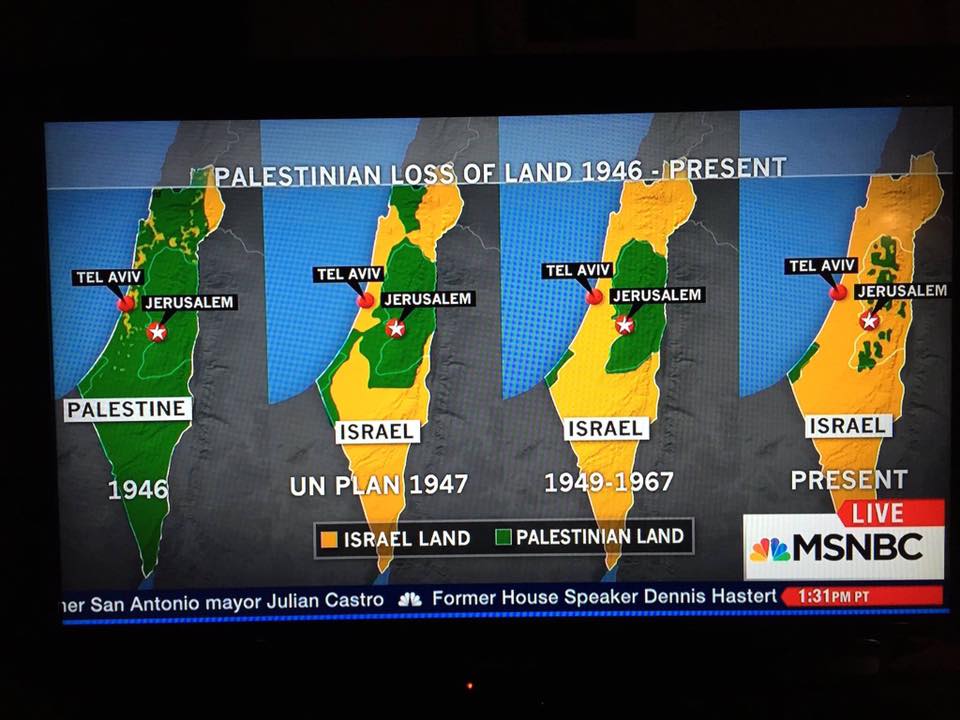
All of this has been dressed up as a “realistic two-state solution”, offering the Palestinians nearly 70 per cent of the occupied territories – which in turn comprise 22 per cent of their original homeland. Put another way, the Palestinians are being required to accept a state on 15 per cent of historic Palestine after Israel has seized all the best agricultural land and the water sources.
Like all one-time deals, this patchwork “state” – lacking an army, and where Israel controls its security, borders, coastal waters and airspace – has an expiry date. It needs to be accepted within four years. Otherwise, Israel will have a free hand to start plundering yet more Palestinian territory. But the truth is that neither Israel nor the US expects or wants the Palestinians to play ball.
That is why the plan includes – as well as annexation of the settlements – a host of unrealisable preconditions before what remains of Palestine can be recognised: the Palestinian factions must disarm, with Hamas dismantled; the Palestinian Authority led by Mahmoud Abbas must strip the families of political prisoners of their stipends; and the Palestinian territories must be reinvented as the Middle East’s Switzerland, a flourishing democracy and open society, all while under Israel’s boot.
Instead, the Trump plan kills the charade that the 26-year-old Oslo process aimed for anything other than Palestinian capitulation. It fully aligns the US with Israeli efforts – pursued by all its main political parties over many decades – to lay the groundwork for permanent apartheid in the occupied territories.
Trump invited both Netanyahu, Israel’s caretaker prime minister, and his chief political rival, former general Benny Gantz, for the launch. Both were keen to express their unbridled support.
Between them, they represent four-fifths of Israel’s parliament. The chief battleground in the March election will be which one can claim to be better placed to implement the plan and thereby deal a death blow to Palestinian dreams of statehood.
On the Israeli right, there were voices of dissent. Settler groups described the plan as “far from perfect” – a view almost certainly shared privately by Netanyahu. Israel’s extreme right objects to any talk of Palestinian statehood, however illusory.
Nonetheless, Netanyahu and his right-wing coalition will happily seize the goodies offered by the Trump administration. Meanwhile the plan’s inevitable rejection by the Palestinian leadership will serve down the road as justification for Israel to grab yet more land.
There are other, more immediate bonuses from the “deal of the century”.
By allowing Israel to keep its ill-gotten gains from its 1967 conquest of Palestinian territories, Washington has officially endorsed one of the modern era’s great colonial aggressions. The US administration has thereby declared open war on the already feeble constraints imposed by international law.
Trump benefits personally, too. This will provide a distraction from his impeachment hearings as well as offering a potent bribe to his Israel-obsessed evangelical base and major funders such as US casino magnate Sheldon Adelson in the run-up to a presidential election.
And the US president is coming to the aid of a useful political ally. Netanyahu hopes this boost from the White House will propel his ultra-nationalist coalition into power in March, and cow the Israeli courts as they weigh criminal charges against him.
How he plans to extract personal gains from the Trump plan were evident on Tuesday. He scolded Israel’s attorney-general over the filing of the corruption indictments, claiming a “historic moment” for the state of Israel was being endangered.
Meanwhile, Abbas greeted the plan with “a thousand nos”. Trump has left him completely exposed. Either the PA abandons its security contractor role on behalf of Israel and dissolves itself, or it carries on as before but now explicitly deprived of the illusion that statehood is being pursued.
Abbas will try to cling on, hoping that Trump is ousted in this year’s election and a new US administration reverts to the pretence of advancing the long-expired Oslo peace process. But if Trump wins, the PA’s difficulties will rapidly mount.
No one, least of all the Trump administration, believes that this plan will lead to peace. A more realistic concern is how quickly it will pave the way to greater bloodshed.


There is no way to peace in a "Middle East plan" that fully adopts the Israeli agenda and ignores the fundamental problem that has continued for more than 70 years.
Palestinians are not striving to improve the conditions of their imprisonment, they want the return of their refugees and the end of the occupation.
As it is, Palestinians are trapped, with very little freedom of movement and no voice to tell their side of the story. That is not going to change with this "deal", especially when the international community turns a blind eye to the reality on the ground for ordinary people.
More than 70 years after the Universal Declaration of Human Rights stipulated the right to freedom of movement, this is not something most Palestinians can contemplate. 
People around the world, who may not even know they have this defined right, exercise it on a daily basis. But for the Palestinians living in the Palestinian occupaied territories - essentially a detention camp surrounded by fences, walls and military towers - to try is to risk your life.
In Gaza and the West Bank, a person's ability to travel is conditional upon obtaining a permit from the Israeli government and then going on a waiting list administered by Gaza's Ministry of the Interior. As a result, the vast majority of Gazans have not left the Strip since the Israeli blockade began in 2007 - not even to see their relatives in the West Bank. The decision to travel is usually made only in cases of extreme need, such as for urgent medical treatment.
And according to the OCHA, 213 Palestinians had been killed since the Great March of Return demonstrations began in March 2018 in Gaza and more than 36,000 injured, many of whom have been left with permanent disabilities. In contrast, no Israelis had died.
Now, as Trump's new Middle East plan silences the voices of Palestinians, their stories, their realities, more than ever, Europe has a decision to make. 
The EU has for years expressed its "deep concerns" over Israel's targeted killings and illegal settlements. But pro-Palestinian activists increasingly face censure and restrictions in European countries.
Last May, Germany passed a symbolic resolution designating the Boycott, Divestment, Sanctions (BDS) movement as anti-Semitic - even though the movement's demands are based on international law and the methods it uses are peaceful. 
In December, the French parliament passed a resolution that labelled anti-Zionism a form of anti-Semitism.
Europe today faces a real test: Will it value the principles of freedom of opinion, expression and movement and the international law that underpins these - or will it help in the continued silencing and stifling of Palestinians? 
If Europe and the international community get behind Trump's Middle East plan - a plan in which the Palestinians have no say - the answer will be clear.

 "Trumps Midle East Plan is a policy of Apartheid and Settler colonialism"
 "Yet another declaration of war on Palestinians"

The Palestinians react as expected

Bottomline: Does the "Deal of the Century" make peace impossible?