
Two dates are often used to frame the so-called Palestinian-Israeli
conflict: Nakba Day on May 15 and Naksa Day on June 5.
Nakba means "catastrophe", a reference that was commonly used to
describe the violence meted out against the Palestinian Arab population during the
period of British colonialism in Palestine, which extended from 1917 to 1948.
The term Nakba morphed to define the zenith of British and Zionist
colonisation and settlement in Palestine, which ultimately led to the ethnic cleansing of the Palestinian
population from their historic homeland in 1947 and 1948.
May 15, 1948, was the final act of all previous "catastrophes".
Naksa, on the other hand, means the "letdown".
In that period, there were high hopes among ordinary Arabs that Arab armies
would manage to defeat Israel, reclaim historic Palestine and pave the road for
the Palestinian refugees - dispossessed during the Nakba - to go back to their
homes.
By then, the number of refugees had grown rapidly, and refugee camps were
bursting at the seams with misery and destitution.
During the Nakba nearly 500 villages
were destroyed, entire Palestinian towns
depopulated and approximately 800,000 Palestinians exiled to make room for
Jewish immigrants who arrived from all corners of the globe.
The 1967 war, however, was a major letdown.
The Arabs were soundly defeated.
Lack of preparedness and hyped expectations on the Arab side, and massive
American-Western military and financial support of Israel, led to a humiliating
defeat for the Arabs on all fronts: the West Bank, Jordan's western border, the
Gaza Strip, the Egyptian Sinai and the Syrian Golan Heights.
That defeat settled the military score decisively for Israel, cementing
US-Israel relations like never before; and, equally important, led to a
fundamental shift in language.
For a long time after the war, the Nakba was largely assigned to the
history books and Israel's new borders - which acquired massive Arab lands,
including the entirety of historic Palestine - became the new frame of
reference.
The 1967 defeat brought an end to a previous dilemma in which the
Palestinian armed struggle was often dictated by Arab countries, mainly Egypt,
Jordan and Syria.
The occupation of the remaining 22 percent of the West Bank shifted the
focus to East Jerusalem, the West Bank and Gaza, and allowed the Palestinian
faction, Fatah, to redefine its role in light of Arab defeat and subsequent
division.
That division was highlighted most starkly in the August 1967 Khartoum
summit, where Arab leaders clashed over priorities and definitions. Should
Israel's territorial gains redefine the status quo ante? Should Arabs focus on
returning to a pre-1967 situation or that of pre-1948?
The Palestine Liberation Organisation (PLO)
insisted that the defeat in the war should not compromise the integrity of the
struggle, and that Palestine - all of Palestine - was still the pressing issue.
The message of Gamal Abdul Nasser, the Egyptian president, seemed, for once,
befuddled, although he continued to advocate for a conventional military
confrontation with Israel.
Syria, on the other hand, did not attend the summit.
Nonetheless, the Arabs agreed that there would be no negotiations, no
recognition and no peace with Israel, whose behaviour continued to be a source
of loss, defeat and hostility throughout the region.
The response to the war was not promising internationally either.
The United Nations Security Council adopted Resolution 242 on November 22, 1967,
reflecting the US Lyndon B Johnson administration's wishes to capitalise on the
new status quo ante. The UN resolution demanded Israeli withdrawal "from
occupied territories" in exchange for normalisation with Israel.
 The new language of the post-1967 period alarmed Palestinians, who realised
that any future political settlement was likely to ignore the situation that
existed prior to the war, and would only attempt to remedy current grievances.
The new language of the post-1967 period alarmed Palestinians, who realised
that any future political settlement was likely to ignore the situation that
existed prior to the war, and would only attempt to remedy current grievances.
Empowered by its military triumph, the 1967 victory was another chance for
Israel to rewrite history. Israel's official language reflected that sense of newfound
power.
In fact, Israel felt powerful enough that it shifted its discourse from
presenting itself only as a victimised country defending its border from Arab hordes
also to a country that had supremacy over history. Although
it conquered all of Palestine and subjugated millions of its inhabitants, it
still declared them non-existent.
Indeed, the infamous declaration once made by former
Israeli Prime Minister Golda Meir that Palestinians "didn't exist"
and that "there is no such a thing as a Palestinian people" was far
more dangerous than a mere racist comment, as justifiably understood by many.
The statement was made two years after the Naksa.
The more land Israel illegally seized by military means and the more
Palestinians were ethnically cleansed from their ancestral
homeland, the more Israeli leaders felt the pressing need to erase Palestinians from the
annals of history as a people with an identity, a culture and an entitlement to
a nationhood.
If Palestinians "existed" in Israel's imagination, there could
never be any moral justification for the creation of Israel; no spin could be
powerful enough to rejoice at the birth of the Israeli "miracle" that
"made the desert bloom".
Israel's violent birth callously required the destruction of a whole nation
- one with a unique history, language, culture and collective memory.
Therefore, the Palestinian people had to be wiped out to quell any possible
sense of Israeli guilt, shame and legal and moral responsibility for what had
befallen millions of a dispossessed people.
If a problem does not exist, then one is under no obligation to fix it.
Thus, the denial of the Palestinian was the only intellectual formulation that
would allow Israel to sustain and promote its national myths.
Not surprisingly, the Israeli logic was convincing enough for those -
driven by political necessity, religious zeal or simply self-deluded - who felt
the need to also celebrate the Israeli "miracle".
Their new mantra, as repeated by one of the
United States' most opportunistic, and indeed, ignorant politicians, Newt
Gingrich a few years ago, was: "Palestinians are an invented people."
This logic seeped through to every facet of Israeli society.
Despite a fledgling movement in Israel that attempts to challenge the
Israeli narrative, in Israeli literature the Palestinian is a "mute
shadow", as poignantly phrased by Elias Khoury.
The shadow is a reflection of something real, but intangible. It is mute so
that it can be talked at, but can never talk back.
The "mute shadow" Palestinian exists and doesn't exist.
But defying common sense and rewriting history is an old Israeli habit.
Israel's official discourse regarding what took place during the Nakba was not
finalised until the 1950s and 60s.
In a Haaretz article entitled Catastrophic Thinking: Did Ben-Gurion Try to
Rewrite History?, Shay Hazkani revealed the intriguing process of how Israel's
first Prime Minister David Ben-Gurion worked closely with a group of Israeli
Jewish scholars to develop a version of events to describe what had taken place
in 1947-48.
Ben-Gurion wanted to propagate a version of history that was consistent
with Israel's political position - yet he still lacked "evidence" to
support that position. The manufactured "evidence" eventually became
"history", and no other narrative was allowed to challenge Israel's
take on the Nakba.
The Israeli leader assigned scholars in the civil service the task of
fashioning an alternative history that continues to permeate Israeli thinking
until this day.
Distracting from history - or the current reality of the horrific
occupation of Palestine - has been in motion for nearly 70 years.
The absurdity of the Israeli celebration of the 50th anniversary of its
occupation of East Jerusalem, the West Bank and Gaza, is not escaping
all Israelis, of course.
"A state that celebrates 50 years of occupation is a state whose sense
of direction has been lost, its ability to distinguish good from evil
impaired," Israeli commentator Gideon Levy wrote in Haaretz. "What
exactly is there to celebrate, Israelis? Fifty years of bloodshed, abuse,
disinheritance and sadism? Only societies that have no conscience celebrate
such anniversaries."
Gideon argues that Israel has won the war of 1967 but has "lost nearly
everything else".
Since then, Israel's arrogance, detestation of international law,
"ongoing contempt for the world, the bragging and bullying" have all
reached unprecedented heights.
Gideon's article is entitled Our Nakba. He is right, of course; but if the Israeli
"Nakba" is to be judged strictly on moral grounds, then the shaming
must start much earlier - at least 20 years before the war of 1967.
More Jewish voices are joining a Palestinian intellectual movement
that has long aimed at redefining the roots of the Palestinian struggle.
Writing in the Forward, Donna Nevel refuses to
accept that the discussion of the conflict in Palestine starts in the war and
occupation of 1967. "Those who
ignore the Nakba - which Zionist and Israeli institutions have consistently
done - are refusing to acknowledge Zionism as illegitimate from the beginning
of its implementation."
This is precisely why Israeli police recently blocked the March of Return, conducted
annually by Palestinians in Israel.
For years, Israel has been wary that a growing movement among Palestinians,
Israelis and others around the world has been pushing for a paradigm shift in
order to understand the roots of the conflict in Palestine.
That new thinking was a rational outcome of the end of the "peace
process" and the demise of the "two-state solution".
Incapable of sustaining its founding myths, yet unable to offer an
alternative, the Israeli government is now using coercive measures to respond
to the budding movement: punishing those who insist on commemorating the Nakba,
fining organisations that participate in such events and even perceiving as
traitors any Jewish individuals and groups that deviate from its official
thinking.
In these cases, coercion hardly works. The March of Return has rapidly grown in size over the past few
years, in defiance of increasingly repressive measures from the Israeli
authorities.
It seems that nearly 70 years after the founding of Israel, the past is
still looming large.
Fortunately, the Palestinian voices that have fought against the official
Israeli narrative are now joined by a growing number of voices worldwide.
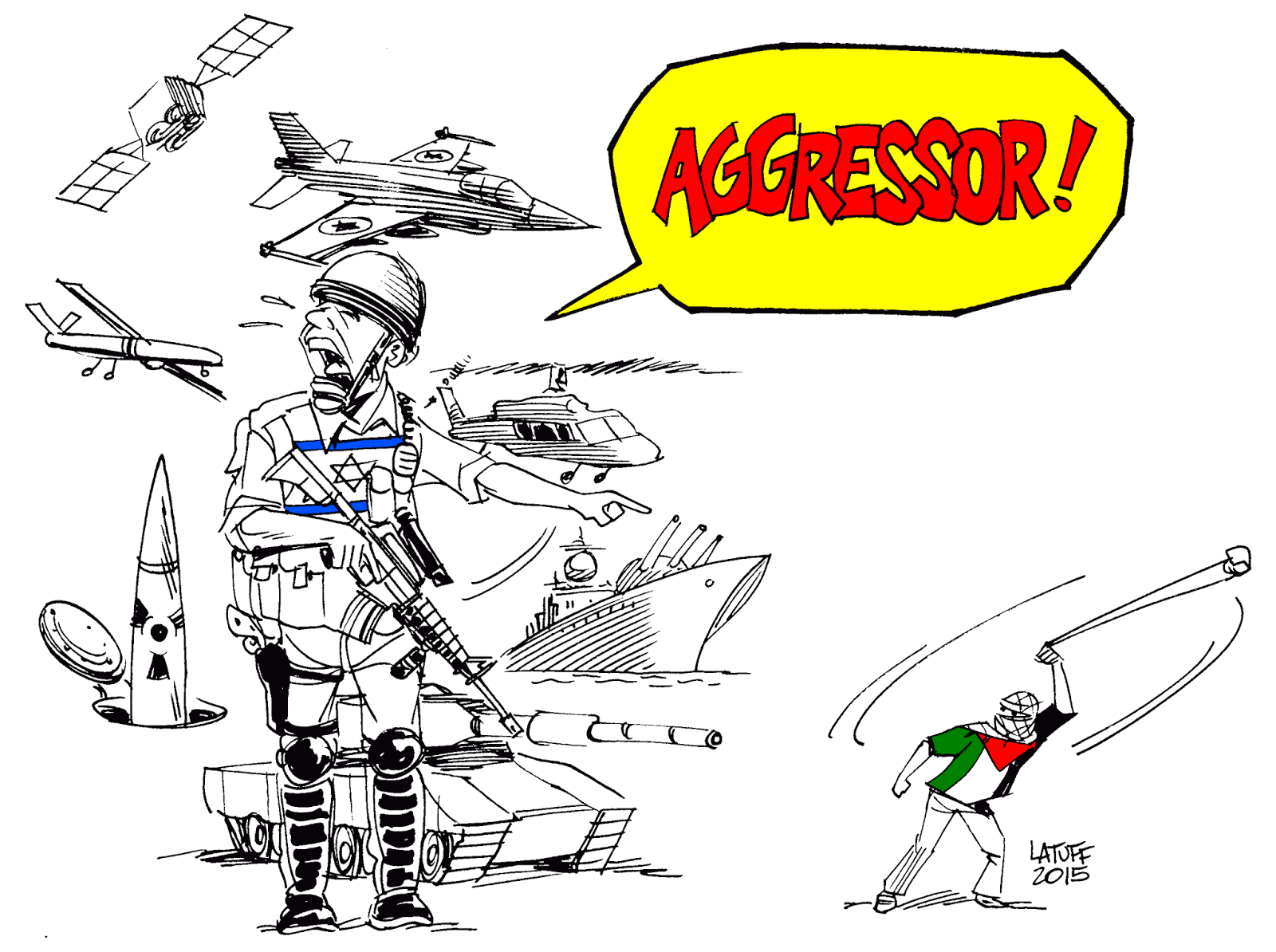 I
am not old enough to remember how the Six-Day War was reported at the
time, but I did a close reading of the subject and learned enough to
understand how the hasbara worked at the time. Just as it is still
working now with Iran and Palestine.
I
am not old enough to remember how the Six-Day War was reported at the
time, but I did a close reading of the subject and learned enough to
understand how the hasbara worked at the time. Just as it is still
working now with Iran and Palestine.
Just
about everything people were told then was wrong, as the major
historians of the period all acknowledge today. Let's start with how the
crisis was reported as it supposedly happened, 50 years ago:
Gamal
Abdel Nasser, president of Egypt, was portrayed as a dangerous
demagogue, widely popular across the Arab world, who wanted to destroy
Israel. The Western press regularly demonized him, and he was easily the
most recognized Arab leader until Saddam Hussein. In May 1967, Nasser
made his move. He ordered the United Nations to remove peacekeeping
troops from the Sinai peninsula, where they had been serving as a
tripwire to prevent conflict between Egypt and Israel. Next, Nasser
escalated by closing the Straits of Tiran to international shipping,
blockading Israel's southern port of Eilat, which started to strangle
the country. Meanwhile, Nasser was plotting with other Arab states,
chiefly Syria and Jordan, to launch a joint invasion and push Israel
into the sea. Fortunately, despite the odds against Israel, it won in
only 6 days! To protect itself against another onslaught, Israel
occupied the Sinai, the Golan heights, and Palestine. The occupation was
the purely accidental consequence of a fight for Israeli survival. The
New York Times even stated as fact that in 1967 "Israel defied
annihilation by its Arab neighbors."
That is what the hasbara made international public opinion believe at the time, and tries to make you believe now.
The
truth of the facts as they really happened is that Nasser and the other
Arab leaders had absolutely no intention of invading Israel in June
1967 and Israel's existence was never in the slightest doubt, as both
Israeli and American leaders knew that Israel could easily crush any
coalition of Arab states.
To
understand the Six-Day War one must go back 11 years, to the 1956 Suez
Crisis, when Nasser nationalized the Suez Canal - and Israel, Britain
and France launched an unprovoked joint invasion of Egypt to seize the
waterway back.
That
time, the United States, under the presidency of Dwight Eisenhower,
opposed the attack and pressured the tripartite invasion force to
withdraw and leave the Canal to Egypt - the US President and his influential Secretary of State John Foster Dulles loathed Nasser and wanted to dispose of Nasser just as much as anyone else; they just didn't think the timing was right for an armed attack. So, Suez was a big failure for all
invading nations, and British prime minister Anthony Eden was forced to
resign. meanwhile, Nasser's reputation in the Arab world, and across
Africa, Asia and Latin America, rose to new heights.
The
fact of the matter is that Israel could not resign itself to
Eisenhower's decision and yearned to complete its failed mission of
1956. To that end, Israel's first goal was to neuter Nasser, to deliver a
death blow to these uppity Arabs that they so much despised, and finish
off what was called "radical Arab nationalism"; and the second goal was
to conquer the lands they had coveted but didn't manage to seize during
the massacres of the Nakba in 1948: the Syrian Golan and Palestine -
the Gaza Strip, the West Bank, and most of all, East Jerusalem.
Israeli
leaders only doubt was what would the USA do if it attacked the Arabs.
Would Washington humiliate them again by forcing them to back down as in
1956 or would look the other way as it had been doing lately, as Israel
had not been minding its own business, but instead regularly and
violently provoking its Arab neighbours.
Actually,
in November 1966, in the largest military action since the Suez
invasion, Israel had even attacked the West Bank town of Samu, then
under Jordanian rule, killing 18 Jordanian soldiers and destroying 125
homes. So Israel continued instigating along its border with Syria in
April 1967, triggering an aerial battle in which 6 Syrian planes were
shot down, including one over Damascus. Voices in the Arab world started
to accuse Nasser, the leader of the Arabs, of standing by and doing
nothing.
So
Nasser did something. He told the United Nations to remove the
peacekeeping troops from Egyptian Sinai, mainly so he could be seen to
be taking some action, knowing that Israel could ask for UN
peacekeepers to be placed on its side of the border, which would have
maintained the tripwire. However, Israelis did no such thing because
they had just what they were hoping to achieve with their provocations -
an excuse to attack playing the victim.
Even
though Nasser's closing of the Straits of Tiran was a legal right, and
he certainly did not intend to maintain the closure, as he offered to
take the dispute to the International Court of Justice - which Israel
refused. And furthermore, Israel would not have choked overnight - it
got 95 percent of its imports through its other ports and had a several
months' reserve supply of oil.
The
only thing that Israel needed was a green light from Washington to
trigger a military operation against the Arabs, knowing that Nasser had
no plans to attack and even if it did, Israel would easily defeat Egypt
on the battlefield, either alone or with any combination of other Arab
nations. This time, it wasn't difficult to convince the US to tacitly
give Israel permission to start the war and assure Tel Aviv that the
White House would not repeat Eisenhower's repudiation after the 1956
Suez invasion.
Once things were settled with the USA, Israel attacked first, backed by England and France. To make a long story short, the "Six-Day War" should be called "Operation Six-Minutes". Once Israeli planes in a surprise blitzkrieg (lightning war - Nazi tactical and operational methodology used during World War II to annihilate the defense forces of its preys) knocked out the Egyptian air force still parked on the ground, the war was over. The war lasted longer only because Israel wanted to conquer the Egyptian Sinai, the Jordanian West Bank, and the Syrian Golan heights.
A word about Nasser who is still the most famous Arab leader, with Saddam Hussein. Nasser was a galvanizing, mesmerizing, orator, who tapped into popular aspirations for a better, more dignified life. It was the era of the Nonaligned Movement, of hopes and expectations as the former European colonies gained independence after World War II. The heads of these newly independent states convened at the Bandung conference in 1955 and the leading and representative figures were the Egyptian Nasser, the Yugoslavian Tito and the Indian Nehru. Nasser was as prominent figure all over the world and the US hoped it could buy him off and rein him in until the Kennedy administration. JFK finally dispaired of trying to bribe him as he was proving too independent, intractable, unpredictable. So Israel got what it wanted, but also did Lyndon Johnson, for a short time. Incidentally, 67 didn't sit easily as the Israel lobby soon imposed on Washington a foreign policy alien to American national interests.
I think that just like the world, Israeli public did believe the mainstream narrative, took to heart the lies and distortion of their government was feeding the mainstream media, and genuinely feared the Arab states wanted to push them into the sea. It was Tel Aviv's way of making the Israeli people give their all if they feared their backs were up against the wall. Israeli leaders who produced this narrative were culpable twice over; they provoked the crisis and then launched an unprovoked attack.
Once the "war" ended, in the United States it was treated as a lark, a thrilling adventure. After Israel occupied the Egyptian Sinai, jokes circulated: "See the Pyramids. Visit Israel."
But it was no joke for the at least 18.000 people who died in the fighting: 10 to 15.000 Egyptians; 6.000 Jordanians; 1.000-2500 Syrians. Even Israel lost 1000 people on its operation of conquest. But it did win its immediate war objectives. Nasser was severely damaged, and he died three years later with his brand of Arab nationalism greatly discredited. And the IDF (Israeli Occupation Forces) did occupy the Sinai, the Golan and Palestine.
Without the "Six-Day War" there would certainly not be ISIS or Al-Qaeda, not mentioning the ethnic cleansing of Palestine. Because the Arabs would have had the emancipation they craved for.
Whether the occupation, now shuddering int its 51st year, has been good for Israel is still to be decided by history.
But for Palestinians, it is a tragedy known as the Naksa.
Once things were settled with the USA, Israel attacked first, backed by England and France. To make a long story short, the "Six-Day War" should be called "Operation Six-Minutes". Once Israeli planes in a surprise blitzkrieg (lightning war - Nazi tactical and operational methodology used during World War II to annihilate the defense forces of its preys) knocked out the Egyptian air force still parked on the ground, the war was over. The war lasted longer only because Israel wanted to conquer the Egyptian Sinai, the Jordanian West Bank, and the Syrian Golan heights.
A word about Nasser who is still the most famous Arab leader, with Saddam Hussein. Nasser was a galvanizing, mesmerizing, orator, who tapped into popular aspirations for a better, more dignified life. It was the era of the Nonaligned Movement, of hopes and expectations as the former European colonies gained independence after World War II. The heads of these newly independent states convened at the Bandung conference in 1955 and the leading and representative figures were the Egyptian Nasser, the Yugoslavian Tito and the Indian Nehru. Nasser was as prominent figure all over the world and the US hoped it could buy him off and rein him in until the Kennedy administration. JFK finally dispaired of trying to bribe him as he was proving too independent, intractable, unpredictable. So Israel got what it wanted, but also did Lyndon Johnson, for a short time. Incidentally, 67 didn't sit easily as the Israel lobby soon imposed on Washington a foreign policy alien to American national interests.
I think that just like the world, Israeli public did believe the mainstream narrative, took to heart the lies and distortion of their government was feeding the mainstream media, and genuinely feared the Arab states wanted to push them into the sea. It was Tel Aviv's way of making the Israeli people give their all if they feared their backs were up against the wall. Israeli leaders who produced this narrative were culpable twice over; they provoked the crisis and then launched an unprovoked attack.
Once the "war" ended, in the United States it was treated as a lark, a thrilling adventure. After Israel occupied the Egyptian Sinai, jokes circulated: "See the Pyramids. Visit Israel."
But it was no joke for the at least 18.000 people who died in the fighting: 10 to 15.000 Egyptians; 6.000 Jordanians; 1.000-2500 Syrians. Even Israel lost 1000 people on its operation of conquest. But it did win its immediate war objectives. Nasser was severely damaged, and he died three years later with his brand of Arab nationalism greatly discredited. And the IDF (Israeli Occupation Forces) did occupy the Sinai, the Golan and Palestine.
Without the "Six-Day War" there would certainly not be ISIS or Al-Qaeda, not mentioning the ethnic cleansing of Palestine. Because the Arabs would have had the emancipation they craved for.
Whether the occupation, now shuddering int its 51st year, has been good for Israel is still to be decided by history.
But for Palestinians, it is a tragedy known as the Naksa.
UPFRONT: After 50 years of occupation, is the Two State solution a fantasy?
True, I have devoted this blog mostly to support Palestinian struggle to achieve what they rightfully deserve: Freedom and Dignity. In spite of this commitment, I have tried to abstain from giving the Palestinians advice. I have expressed my views and voiced them many times, but from that point to giving advice, the distance is great.
Now, too, I am not ready to give advice to the Palestinians in general, and to nobody in particular. But I take the liberty to make some remarks about what some defenders of One State propose that the Palestinians do.
The first step is clear: break up the Palestinian Authority and return all the organs of Palestinian self-government to the Israeli military governor, which already rules through Mahmoud Abbas.
That is simple. But then follow general proposals. "Non-violent mass protests", "boycott, divestment and sanctions", "addressing the rights of Palestinian refugees" (from the 1948 war) and the "Palestinian citizens of Israel". She mentions approvingly that already more than a third of the Palestinian people in the occupied territories support a single-state solution - meaning a bi-national state.
With due respect, will these remedies - all together and each one separately - liberate the Palestinian people? I don't believe it will.
Experience shows that it is easy for the occupation authorities to turn a "non-violent mass protest" into a very violent one. That happened in both intifadas, and especially in the second. It started with non-violent actions, and then the occupation authorities called in snipers. Within a few days the intifada became violent.
The use of boycotts? There is now in the world a large and useful movement of BDS against Israel. The Israeli government is afraid of it and fights against it with all means, including ridiculous ones. This fear does not spring only from the economic damages this movement can cause, but from the damage it may cause to Israel's image as well. Such image may hurt, but it does not kill. The racist regime in South Africa was not brought down by foreigner, but by those despised "natives". The blacks started campaigns of armed struggle (yes, the great Nelson Mandela was a "terrorist") and mass strikes, which brought down the economy. The international boycott played a very welcome supporting role.
What about the International Court in the Hague. Israel spits on them, as it spit on the UN resolution at its time.
What is left? There is only one alternative: violence. It is the only argument that Israel listens to.
Many peoples throughout history started wars of liberation, violent struggles against their oppressors. In Israeli jargon that is called "terror'.
Let's ignore for a moment the reprehensible aspect of violence and concentrate on the practical aspect only: could a violent campaign by the occupied people against the occupying mighty army, under existing circumstances, succeed? The Israeli security services have shown during the Second Intifada considerable ability in fighting against armed resistance, at least if this resistance is not massive.
If not armed resistance, what remains for the Palestinians to do? To "hold on", as Mahmoud Abbas does? Abbas uses Petain's "tactic", supported by some outsiders, as the French General saved Paris from destruction and made it possible for most of the French people to survive the occupation and when the Nazi empire broke down, France, under Charles de Gaulle, joined the victors God knows why.
The problem is that Petain's strategy of cowardness spared France because the Nazi occupied the country for a couple of years, not for seven decades, and Hitler did not install colonies of Germans all over the territory to grab french land and did not wall them in open air prisons.
How would the French have reacted if the Nazis had occupied their country forever?
How to survive year after year, decade after decade, on your knees and without hope of ever be able to stand up?
Not long ago, a leader of the Israeli fascist right, Betsalel Smotrich, a deputy chairman of the Knesset, published an ultimatum to the Palestinians: to leave the country, to live in the country without citizenship rights or to rise up in arms - and then the Israeli army "would know how to deal with them". In simple words: the choice is between (a) the mass expulsion of seven million Palestinians from the West Bank (including East Jerusalem), Israel proper and the Gaza Strip, which would amount to Genocide, (b) life as a people of slaves under an Apartheid regime and (c) simple genocide.
The One State solution constitutes, in practice, the second choice. Which is a dramatic suicide.
After all these years, the only practical solution remains as it was at the beginning: two states for two peoples. Without walls and without the Israeli colonies in the West Bank. Two states that will live side by side in peace, perhaps even in friendship. I can't see any other viable solution.
The fact of the matter is, how to achieve it fairly without pushing Israel to the edge?
Jeremy Corbin might bring the solution we are hoping for.
Now, too, I am not ready to give advice to the Palestinians in general, and to nobody in particular. But I take the liberty to make some remarks about what some defenders of One State propose that the Palestinians do.
The first step is clear: break up the Palestinian Authority and return all the organs of Palestinian self-government to the Israeli military governor, which already rules through Mahmoud Abbas.
That is simple. But then follow general proposals. "Non-violent mass protests", "boycott, divestment and sanctions", "addressing the rights of Palestinian refugees" (from the 1948 war) and the "Palestinian citizens of Israel". She mentions approvingly that already more than a third of the Palestinian people in the occupied territories support a single-state solution - meaning a bi-national state.
With due respect, will these remedies - all together and each one separately - liberate the Palestinian people? I don't believe it will.
Experience shows that it is easy for the occupation authorities to turn a "non-violent mass protest" into a very violent one. That happened in both intifadas, and especially in the second. It started with non-violent actions, and then the occupation authorities called in snipers. Within a few days the intifada became violent.
The use of boycotts? There is now in the world a large and useful movement of BDS against Israel. The Israeli government is afraid of it and fights against it with all means, including ridiculous ones. This fear does not spring only from the economic damages this movement can cause, but from the damage it may cause to Israel's image as well. Such image may hurt, but it does not kill. The racist regime in South Africa was not brought down by foreigner, but by those despised "natives". The blacks started campaigns of armed struggle (yes, the great Nelson Mandela was a "terrorist") and mass strikes, which brought down the economy. The international boycott played a very welcome supporting role.
What about the International Court in the Hague. Israel spits on them, as it spit on the UN resolution at its time.
What is left? There is only one alternative: violence. It is the only argument that Israel listens to.
Many peoples throughout history started wars of liberation, violent struggles against their oppressors. In Israeli jargon that is called "terror'.
Let's ignore for a moment the reprehensible aspect of violence and concentrate on the practical aspect only: could a violent campaign by the occupied people against the occupying mighty army, under existing circumstances, succeed? The Israeli security services have shown during the Second Intifada considerable ability in fighting against armed resistance, at least if this resistance is not massive.
If not armed resistance, what remains for the Palestinians to do? To "hold on", as Mahmoud Abbas does? Abbas uses Petain's "tactic", supported by some outsiders, as the French General saved Paris from destruction and made it possible for most of the French people to survive the occupation and when the Nazi empire broke down, France, under Charles de Gaulle, joined the victors God knows why.
The problem is that Petain's strategy of cowardness spared France because the Nazi occupied the country for a couple of years, not for seven decades, and Hitler did not install colonies of Germans all over the territory to grab french land and did not wall them in open air prisons.
How would the French have reacted if the Nazis had occupied their country forever?
How to survive year after year, decade after decade, on your knees and without hope of ever be able to stand up?
Not long ago, a leader of the Israeli fascist right, Betsalel Smotrich, a deputy chairman of the Knesset, published an ultimatum to the Palestinians: to leave the country, to live in the country without citizenship rights or to rise up in arms - and then the Israeli army "would know how to deal with them". In simple words: the choice is between (a) the mass expulsion of seven million Palestinians from the West Bank (including East Jerusalem), Israel proper and the Gaza Strip, which would amount to Genocide, (b) life as a people of slaves under an Apartheid regime and (c) simple genocide.
The One State solution constitutes, in practice, the second choice. Which is a dramatic suicide.
After all these years, the only practical solution remains as it was at the beginning: two states for two peoples. Without walls and without the Israeli colonies in the West Bank. Two states that will live side by side in peace, perhaps even in friendship. I can't see any other viable solution.
The fact of the matter is, how to achieve it fairly without pushing Israel to the edge?
Jeremy Corbin might bring the solution we are hoping for.

A decision by Donald Trump last Thursday proved fateful for the immediate future of Jerusalem, the wider Israeli-Palestinian conflict and the region.
He decided to renew a presidential waiver that expired on June 1.
The six-month waiver delays implementing a law passed by Congress in
1995 that requires the U.S. to recognize occupied Jerusalem as Israel’s
capital and relocate its embassy there from Tel Aviv.
It
is a law every president for the past 22 years has balked at. It would
pre-empt the Oslo accords and negate Washington’s assumed role as
“honest broker”. Carrying out Congress’s wish would deny the
Palestinians East Jerusalem, the only credible capital of a future
Palestinian state.
But equally
significantly, the law would recognise Israel’s efforts to claim
sovereignty over the Old City’s holy places, which means all Christian
churches and sites, and the incendiary site of Al Aqsa mosque. That
could provoke a conflagration both locally, among Palestinians, and more
generally in the Middle East.
Trump’s
key advisers were reported to be bitterly divided and Israeli prime
minister Binyamin Netanyahu and his allies in the US Congress, even
after the deal was done, are still doing their best to pressure Trump in
the opposite direction.
Last Sunday,
Netanyahu staged a provocative stunt, holding his weekly cabinet
meeting in a tunnel under Al Aqsa mosque compound to announce measures
to bring millions more Jewish visitors to the occupied Old City,
including a new cable car to the edge of the mosque.
It
was Netanyahu’s decision to open the Western Wall Tunnel in 1996, when
he first became prime minister, that brought the Oslo process into
almost terminal crisis at an early stage. Three days of clashes killed
more than 100 Palestinians and 17 Israeli soldiers.
The
day after Trump’s departure from Israel a few days ago, Netanyahu
exploited the president’s attendance at the wall to further damage
prospects for peacemaking. He made a provocative speech to mark
“Jerusalem Day”, Israel’s annual show of strength in East Jerusalem.
He
claimed that Trump had disproved the “lies” promoted by the United
Nations cultural body, Unesco, when it voted this month to re-state that
Jerusalem is occupied.
In truth, it
was Netanyahu who indulged in gross mendacity, claiming that East
Jerusalem had been “desolate” and “neglected” before its occupation.
Israel had “redeemed” the city, he said, while Al Aqsa mosque would
“always remain under Israeli sovereignty”.
His
supporters tried to give that claim concrete expression by staging the
largest-ever march through the Old City on Jerusalem Day. Palestinians
were forced into hiding or fled early as police allowed 60,000 Jewish
ultra-nationalists to besiege the heart of East Jerusalem.
In
a sign of the power balance in Israel, a small group of 50 left-wing
Jews – many from the U.S. – linked arms to try to block the march at the
Old City’s entrance. Footage showed police brutally arresting them, grabbing them in chokeholds and breaking one woman’s arm.
Jerusalem
is the most intractable of the final-status issues set out in the Oslo
process. Those expecting miracles of Trump are going to be disappointed.
His commitment to pressuring Netanyahu is weak, while the Israeli prime
minister’s commitment to making concessions is non-existent.
Ilan Pappe: The Myth of Israel

. Gush Shalom: Settlement Products Wikia
. Haaretz: Israel is not a democracy - Six-Day War – 50 years.
. Charlotte Silver: Israel main cause of Palestinian suffering, UN says.
. Mondoweiss : The responsibility of non-Zionist Jews during the 'year of Zionist anniversaries.
. Hamas New Charter: Meshaal’s Gamble on The Losing Horse
. Football in the Holy Land: The Superstar
. Concordo plenamente que "a ignorância 'astravanca' o progresso", mas este caso é engraçado. Uma companhia aérea estadunidense upgrade um advogado palestino para a classe executiva em um assento vizinho do minstro israelense Naftali Bennett que adora contar quantos palestinos ele matou quando servia a IDF. Como o palestino tem a nacionalidade israelense, não foi revistado no check in e nem foi suspeitado de nada: A Palestinian's first-class seat next to Naftali Bennett.

BRASIL - DIRETAS, JÁ!


Jornalistas Livres (@j_livres) | Twitter
.
Let's have some fun with UK & USA bad apples
Watch Stuart Jones, a high-level acting official in the USA State Dept., reacting to the question why they criticize Iranian elections while supporting Saudi Arabia rogue regime.
Capitain SKA exposes Theresa May


